概要
この文書は、Web of Things (WoT) Thing
Description (TD) バージョン 2.0 のための、正式な情報モデルと
共通表現を記述する。Thing Description は、
Things
のメタデータとインターフェイスを記述するものであり、
ここで Thing
は、相互作用を提供し、
Web of Things に参加する物理的または仮想的なエンティティの抽象である。
Thing Description は、小さな語彙に基づく
一連の相互作用を提供し、多様なデバイスを統合することと、
多様なアプリケーションの相互運用を可能にする。Thing Description は、既定では
JSON-LD 処理も可能な JSON 形式で符号化される。
後者は、Things
に関する知識を機械可読な
方法で表現するための強力な基盤を提供する。Thing Description インスタンスは、
Thing
自身によってホストすることも、
Thing に
リソース上の制約(例: 限られたメモリ空間)がある場合や、
Web of Things 互換のレガシーデバイスに Thing
Description を後付けする場合には外部でホストすることもできる。
さらに、この文書は Thing Model を導入する。Thing Model により、
作成者は Internet of Things (IoT) エンティティのモデルまたはクラスのみを
記述できる。Thing Model は Thing Description インスタンスの
テンプレートと見なすことができるが、特定の通信メタデータに対する
要件が存在しない、または少ないなど、制約が軽減されている。
この仕様は [WOT-THING-DESCRIPTION11
目次
概要
この文書のステータス
1. はじめに
1.1 Thing Description
1.2 Thing Model
2. 適合性
3. 用語
4. 名前空間
5. TD
情報モデル
5.1 概要
5.2
準備事項
5.3 クラス
定義
5.3.1
コア語彙定義
5.3.1.1
Thing
5.3.1.2
InteractionAffordance
5.3.1.3
PropertyAffordance
5.3.1.4
ActionAffordance
5.3.1.5
EventAffordance
5.3.1.6
VersionInfo
5.3.1.7
MultiLanguage
5.3.2 データスキーマ語彙定義
5.3.2.1
DataSchema
5.3.2.2
ArraySchema
5.3.2.3
BooleanSchema
5.3.2.4
NumberSchema
5.3.2.5
IntegerSchema
5.3.2.6
ObjectSchema
5.3.2.7
StringSchema
5.3.2.8
NullSchema
5.3.3 セキュリティ語彙
定義
5.3.3.1
SecurityScheme
5.3.3.2
NoSecurityScheme
5.3.3.3
AutoSecurityScheme
5.3.3.4
ComboSecurityScheme
5.3.3.5
BasicSecurityScheme
5.3.3.6
DigestSecurityScheme
5.3.3.7
APIKeySecurityScheme
5.3.3.8
BearerSecurityScheme
5.3.3.9
PSKSecurityScheme
5.3.3.10
OAuth2SecurityScheme
5.3.4 ハイパーメディア制御語彙
定義
5.3.4.1
Link
5.3.4.2
Form
5.3.4.2.1 op 値の
データスキーマへのマッピング
5.3.4.2.2 応答関連
用語の使用法
5.3.4.3
ExpectedResponse
5.3.4.4
AdditionalExpectedResponse
5.4
既定値定義
6. TD 表現形式
6.1
JSON 型へのマッピング
6.2
既定値の省略
6.3
情報モデルのシリアル化
6.3.1
Thing ルートオブジェクト
6.3.2 人間可読メタデータ
6.3.3
version
6.3.4
securityDefinitions および
security
6.3.4.1
複数のセキュリティ
定義
6.3.4.2 Forms における
security
6.3.4.3
ComboSecurityScheme
6.3.4.4
OAuth 2.0 の使用法
6.3.4.5 API
キーの使用法
6.3.5
properties
6.3.6
actions
6.3.7
events
6.3.8
links
6.3.9
forms
6.3.9.1
uriVariables
6.3.9.2
contentType
6.3.9.3
response
6.3.9.4
additionalResponses
6.3.9.5 contentMediaType および
contentEncoding
6.3.9.6 トップ
レベルの
forms
6.3.10 データスキーマ
6.4
識別
6.5
検証
6.5.1 最小検証
6.5.2 基本検証
6.5.3 完全検証
7. TD
コンテキスト拡張
7.1
セマンティック注釈
7.1.1 例 I: 追加の基本
メタデータ
7.1.2 例 II: 状態
注釈
7.1.3 例 III: 地理位置
注釈
7.2 バインディングの追加
7.3
セキュリティスキームの追加
8. バインディング
8.1
バインディング機構
8.1.1
プロトコルバインディング
8.1.1.1
サブプロトコル
8.1.1.2 Thing
Description とプロトコルバインディングの使用
8.1.2
ペイロードバインディング
8.1.2.1 コンテンツタイプ
8.1.2.2 データスキーマ
8.1.3 プロトコル
およびペイロード
バインディング
8.2
プロファイルとの関係
9. 振る舞いに関するアサーション
9.1
セキュリティ設定
9.2 データスキーマ
10. Thing Model
10.1
基本概念
10.2 Thing Model
宣言
10.3
モデリングツール
10.3.1
バージョン管理
10.3.2
拡張およびインポート
10.3.3
構成
10.3.4
tm:optional
10.3.5
プレースホルダー
10.4 Thing
Description
インスタンスの派生
10.5
例
11.
セキュリティの考慮事項
11.1
TD の傍受および改ざん
11.2 コンテキストの傍受および改ざん
11.3
期間限定アクセス
11.4 脆弱性監査
11.5 スクリプトインジェクション
11.6
JSON 解析
11.7 JSON-LD 展開
12.
プライバシーの考慮事項
12.1
コンテキスト取得
12.2 不変の
識別子
12.3
フィンガープリンティング
12.4
ID メタデータ
12.5 グローバルに一意な識別子
12.6
個人を識別可能な情報の
推論
13. IANA に関する考慮事項
13.1
application/td+json メディアタイプ
登録
13.2
application/tm+json メディアタイプ
登録
13.3
CoAP Content-Format 登録
13.3.1 WoT
Thing Description
13.3.2
WoT Thing Model
A. プロトコルバインディングを伴う
Thing Description インスタンスの例
A.1 CoAP
プロトコルバインディングを伴う MyLampThing
の例
A.2
MQTT プロトコルバインディングを伴う
MyIlluminanceSensor の例
A.3
Webhook イベントの例
A.4
HTTP、CoAP、
および MQTT プロトコルバインディングを伴う Lamp
Thing
A.5 HTTP、
CoAP、および MQTT プロトコルバインディングの混在を伴う Lamp
Thing
B.
TD インスタンス検証用 JSON Schema
C. Thing
Descriptions における contentType の使用法
D. JSON-LD コンテキストの使用法
E. IoT プラットフォームおよび標準に由来する
ペイロードとデータスキーマの例
F. 最近の仕様変更
F.1
2023年12月05日の勧告からの変更
G. 謝辞
H. 参考文献
H.1
規範参考文献
H.2
参考情報文献
この仕様の
5. TD Information ModelTD
Information Model のバージョンは、
次の IRI によって識別される:
https://www.w3.org/ns/wot-next/td
この IRI [RFC3987 RFC3986 JSON-LD context file
[json-ld11 TD Documents 内のコンパクトな文字列を、
完全な IRI ベースの Vocabulary
Terms に展開できる。ただし、この処理が必要になるのは、
JSON ベースの TD Documents を RDF に変換する場合のみであり、
これは TD Processor
実装の任意機能である。
注記
この名前空間は、仕様が Recommendation ステータスに達するまでの
一時的なものであることに注意。その時点で、永続的な名前空間が割り当てられる。
一時名前空間を使用するすべての文書は、仕様の git
リポジトリの main ブランチを指すため、安定していない。
本仕様では、Vocabulary Terms は常に
コンパクト形式で提示される。その展開形式は、それらが属する
Vocabulary の名前空間 IRI の下で
アクセスできる。これらの名前空間は、5.3
Class
DefinitionsTD Information Model で使用される
各 Vocabulary は、それぞれ次の独自の名前空間 IRI を持つ:
表 1 TD で使用される
名前空間
語彙
名前空間 IRI
Core
https://www.w3.org/ns/wot-next/td-ontology
Data Schema
https://www.w3.org/ns/wot-next/json-schema-ontology
Security
https://www.w3.org/ns/wot-next/security-ontology
Hypermedia Controls
https://www.w3.org/ns/wot-next/security-ontologyy
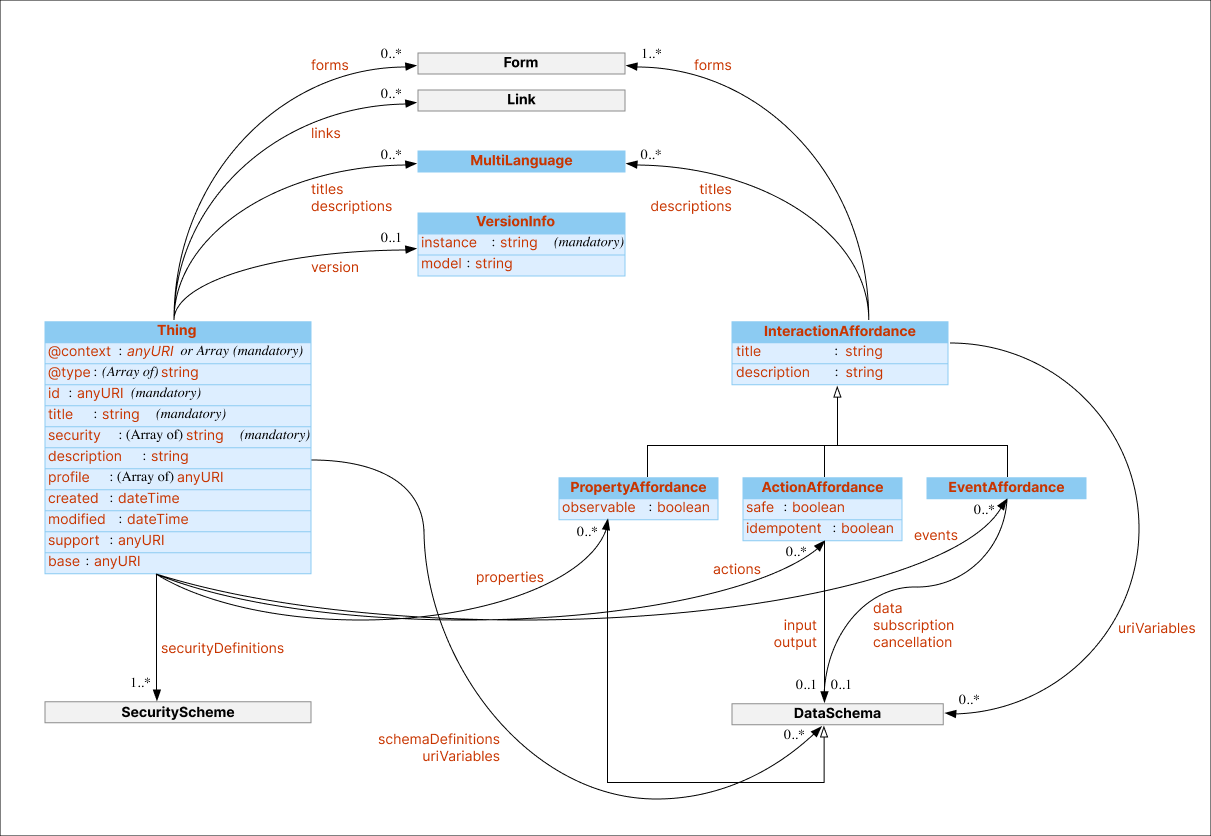
Thing
Model 定義のために
追加で使用されるすべての語彙は、次の名前空間 IRI を持つ:
表 2 TM で使用される
名前空間
語彙
名前空間 IRI
Thing Model
https://www.w3.org/ns/wot-next/tm-ontology
Vocabularies は互いに独立している。
それらは他の
W3C
仕様で再利用および拡張され得る。
Vocabulary の設計における
すべての破壊的変更には、新しい年ベースの名前空間 URI の割り当てが必要となる。
TD
Information Model の全体的な一貫性を
維持するため、関連する JSON-LD context file は、各バージョンが独自の URI
(v1、v1.1、
v2、...)を持つようにバージョン管理され、
非破壊的変更、特に新しい Terms
の追加も識別することに注意。
何らかの名前空間 IRI の下にある Vocabulary は
非破壊的変更のみを受けることができるため、その内容はアプリケーション内で
安全にキャッシュまたは埋め込みできる。名前空間 IRI の下で比較的静的な内容を
公開する利点の 1 つは、制約のあるデバイス間で交換されるメッセージの
ペイロードサイズを最適化することである。また、プライベートネットワークから
公開語彙へアクセスするデバイスに起因するプライバシー漏洩も回避する
(12. プライバシーの考慮事項
このセクションでは、TD
Information Model を導入する。
TD
Information Model
は、Thing Descriptions の処理およびそれらのシリアル化のための概念的基盤として機能する。
シリアル化については、
6. TD Representation
Format
A
TD
Processor は、5.3.1
コア語彙
定義5.3.2 データスキーマ
語彙定義5.3.3 セキュリティ語彙
定義5.3.4 ハイパーメディア制御
語彙定義Classes
について、Class
のインスタンス化制約を
MUST 満たす。
特に、すべての語彙用語と値は大文字・小文字を区別することに注意。
これは情報モデルのシリアル化
(6. TD 表現形式
メタデータとインターフェイスが WoT Thing
Description によって記述される、物理的または仮想的なエンティティの抽象。
ここで仮想的なエンティティは、1 つ以上の Things の合成である。
表
3 Thing
レベルの語彙用語
語彙用語
説明
割り当て
型
@contextTD 文書全体で使用される、terms と呼ばれる
短縮名を定義する JSON-LD キーワード。
必須
anyURI または Array
@type
オブジェクトに semantic tags
(または型)を付与する JSON-LD キーワード。
任意
string または Array of
string
idURI 形式の Thing の識別子
[RFC3986
任意
anyURI
title既定言語に基づく人間可読なタイトル
(例: UI 表現用のテキストを表示)を提供する。
必須
string
titles複数言語の人間可読なタイトル
(例: 異なる言語で UI 表現用のテキストを表示)を提供する。
MultiLanguage
任意
Map of MultiLanguage
description既定言語に基づく追加の(人間可読な)
情報を提供する。
任意
string
descriptions異なる言語による(人間可読な)
情報をサポートするために使用できる。
MultiLanguage
任意
Map of MultiLanguage
versionバージョン情報を提供する。
任意
VersionInfo
createdTD インスタンスが作成された時点に関する
情報を提供する。
任意
dateTime
modifiedTD インスタンスが最後に変更された時点に関する
情報を提供する。
任意
dateTime
supportTD メンテナーに関する情報を URI スキームとして
提供する(例: mailto
[RFC6068 tel [RFC3966 https [RFC9112
任意
anyURI
baseTD 文書全体のすべての相対 URI 参照に使用される
ベース URI を定義する。TD インスタンスでは、すべての相対 URI は
[RFC3986 base は、@context で使用される URI、
および TD インスタンスにセマンティック処理が適用される場合に関連する
Linked Data [LINKED-DATA
任意
anyURI
properties
Thing のすべての Property ベースの
Interaction
Affordances 。
任意
Map of PropertyAffordance
actions
Thing のすべての Action ベースの
Interaction
Affordances 。
任意
Map of ActionAffordance
events
Thing のすべての Event ベースの
Interaction
Affordances 。
任意
Map of EventAffordance
links指定された Thing Description に関連する任意のリソースへの
Web リンクを提供する。
任意
Array of Link
forms
操作をどのように実行できるかを記述する form ハイパーメディア制御の集合。
Forms は Protocol Bindings のシリアル化である。
Thing
level
forms は、interaction affordances のグループのエンドポイントを
記述するために使用される。
任意
Array of Form
securitysecurityDefinitions で定義されたものから選択される
セキュリティ定義名の集合。
リソースへアクセスするには、これらすべてが満たされなければならない。必須
string または Array of
string
securityDefinitions名前付きセキュリティ構成の集合
(定義のみ)。security
name-value pair で名前が使用されない限り、実際には適用されない。
必須
Map of SecurityScheme
profileこの Thing Description および対応する Thing 実装が従う
WoT Profile 機構を示す。
任意
anyURI または Array of
anyURI
schemaDefinitions名前付きデータスキーマの集合。
AdditionalExpectedResponse
オブジェクト内の schema name-value pair で
使用される。
任意
Map of DataSchema
uriVariables
[RFC6570 Thing
level
の uriVariables は、
Thing
level
forms または Interaction Affordances で使用できる。
個々の変数 DataSchema は ObjectSchema または ArraySchema にすることはできない。
各変数は、操作の実行時に href 内で文字列へ
シリアル化される必要があるためである。同じ変数が
Thing level
uriVariables と Interaction
Affordance level の両方で宣言されている場合、Interaction Affordance
level の変数が優先される。
任意
Map of DataSchema
注記
以下の @context URL 規則に関する
リスト項目は、大きく変更される予定である。
@context については、
Thing Description
インスタンスに対して次の規則が定義される:
@context name-value pair は、文書を TD 1.1 として識別し、
Consumers が新たに導入された用語を
使用できるようにするため、anyURI
https://www.w3.org/2022/wot/td/v1.1 を
含まなければならない(MUST )。 TD 1.0 consumers が
存在する可能性がある場合、anyURI
https://www.w3.org/2019/wot/td/v1
は最初の項目でなければならず(MUST )、
https://www.w3.org/2022/wot/td/v1.1
は 2 番目の項目でなければならない
(MUST )。 TD 1.1 consumers は、
W3C WoT
Thing Description 1.0 [wot-thing-description10 MUST )。
@context が Array である場合、anyURI
https://www.w3.org/2022/wot/td/v1.1
の後に、型 anyURI または型
Map の要素を任意の順序で続けてもよい
(MAY @context Array 内のすべての name-value pair を含む
Map
は 1 つだけ含めることが推奨される
(RECOMMENDED )。
@context Array に含まれる
Maps は、値が型
anyURI の名前空間識別子であり、
名前がその名前空間を表す
Term または接頭辞である
name-value pair を含んでもよい
(MAY )。
@context Array に含まれる 1 つの
Map は、
Thing Description の既定言語を定義する name-value pair を含むべきである
(SHOULD )。ここで、名前は
Term @language であり、
値は [BCP47 en、de-AT、
gsw-CH、zh-Hans、
zh-Hant-HK、
sl-nedis)。
Thing Description
および Thing
Model インスタンス内のすべての人間可読テキストの基底方向を決定するため、
この仕様は、基底方向メタデータを関連付ける組み込み機構が利用できない場合に、
[STRING-META
文字列固有の方向情報 に関する指針に従うことを推奨する。
TD
Processors は、双方向テキストを処理する際の特定の特殊ケースを
認識しておくべきである。TD Processors は、
ユーザーに文字列を提示するとき、特に周囲のテキストに埋め込む場合
(例: Web ユーザーインターフェイス)には、
bidi isolation を使用するよう注意すべきである
(SHOULD )。
TD producers は、
素朴なユーザーエージェントでも正常に表示できる方法で
混在方向文字列を提供するよう試みるべきである
(SHOULD )。 たとえば、RTL 文字列が
LTR の並び(数字、ラテン文字のブランド名や商標名など)で始まる場合、
文字列の先頭に RLM 文字を含める、または反対方向の並びを bidi controls で
囲むことで、適切な表示を支援できる。
Strings on the Web: Language and Direction
Metadata [string-meta
properties、
actions、および events
Maps
内に明示的に提供される
Interaction
Affordances に加えて、Thing は
meta-interactions も提供できる。これは任意の
forms Array 内の
Form インスタンスによって示される。
Thing インスタンスの
forms Array が
Form インスタンスを含む場合、それは op メンバーを
含まなければならず(MUST )、
name op に割り当てられた文字列値は、直接または
Array 内のいずれかで、
次の operation
types のいずれかでなければならない
(MUST ):
readallproperties、
writeallproperties、
readmultipleproperties、
writemultipleproperties、
observeallproperties、
unobserveallproperties、
queryallactions、
subscribeallevents、または
unsubscribeallevents。form の使用例については、例 を参照。)
各 property meta-interaction のデータスキーマは、
各 PropertyAffordance インスタンスのデータスキーマを
単一の ObjectSchema インスタンスに結合することで構築される。
ここで、ObjectSchema インスタンスの
properties Map は、
対応する PropertyAffordances インスタンスの名前によって識別される
各 PropertyAffordances のデータスキーマを含む。
別途指定されていない限り(例: TD Context
Extension を通じて)、
readmultipleproperties 操作のリクエストデータは、
意図された PropertyAffordances インスタンス名を含む
Array であり、
Form インスタンスによって指定される content type へ
シリアル化される。
Consumers に可能な選択肢を示し、
それによって Consumers が Thing とどのように相互作用できるかを
示唆する Thing のメタデータ。潜在的な affordance には多くの種類があるが、
W3C
WoT は Interaction Affordances として
Properties、Actions、Events の 3 種類を定義する。
表 4 InteractionAffordance
レベルの語彙用語
語彙用語
説明
割り当て
型
@type
オブジェクトに semantic tags
(または型)を付与する JSON-LD キーワード。
任意
string または Array of
string
title既定言語に基づく人間可読なタイトル
(例: UI 表現用のテキストを表示)を提供する。
任意
string
titles複数言語の人間可読なタイトル
(例: 異なる言語で UI 表現用のテキストを表示)を提供する。
MultiLanguage
任意
Map of MultiLanguage
description既定言語に基づく追加の(人間可読な)
情報を提供する。
任意
string
descriptions異なる言語による(人間可読な)
情報をサポートするために使用できる。
MultiLanguage
任意
Map of MultiLanguage
forms操作をどのように実行できるかを記述する
form ハイパーメディア制御の集合。
Forms は Protocol Bindings のシリアル化である。
配列は空であってはならない。
必須
Array of Form
uriVariables
[RFC6570 href 内で文字列へ
シリアル化される必要があるためである。同じ変数が
Thing level
uriVariables と Interaction
Affordance level の両方で宣言されている場合、Interaction Affordance
level の変数が優先される。
任意
Map of DataSchema
InteractionAffordance クラスは、次の
サブクラスを持つ:
Thing の状態を公開する Interaction Affordance。
この状態はその後、取得(read)および/または
更新(write)できる。Things は、変更後に新しい状態を
プッシュすることで、Properties を observable にすることも
選択できる。
表 5
PropertyAffordance
レベルの語彙用語
語彙用語
説明
割り当て
型
observableThing をホストする Servients および
Intermediaries が、この
Property に対する
observeproperty および
unobserveproperty 操作をサポートする
Protocol Binding を提供すべきかどうかを示す
ヒント。
デフォルトあり
boolean
注記
Property インスタンスは、
DataSchema クラスのインスタンスでもある。
したがって、とりわけ
type、unit、
readOnly、writeOnly
メンバーを含むことができる。
PropertyAffordance は、
InteractionAffordance Class および
DataSchema Class の
Subclass である。Form
インスタンスが PropertyAffordance
インスタンス内にある場合、op に割り当てられる値は
MUST
readproperty、writeproperty、
observeproperty、
unobserveproperty のいずれか、またはこれらの用語の組み合わせを含む
Array
でなければならない。
注記
プロトコルが暗黙的な購読解除機構(例:
接続喪失を検出するハートビート)をサポートしている場合を除き、
各 observeproperty には対応する
unobserveproperty があることが
良い実践と見なされる。
注記
観測機構は、基礎となるプロトコルまたは
サブプロトコルに依存する。とはいえ、購読が開始された時点で
現在の Property 値が
提供されることは保証されない。
したがって、最初の値を取得するために、購読の前/後に現在の
Property 値を
読み取る必要がある場合がある。
Thing の関数を呼び出せるようにする
Interaction Affordance であり、状態を操作する(例:
ランプのオン/オフを切り替える)か、Thing 上で
プロセスをトリガーする(例: 時間をかけてランプを暗くする)。
表
6 ActionAffordance
レベルの語彙用語
語彙用語
説明
割り当て
型
inputAction の入力データスキーマを定義するために
使用される。
任意
DataSchema
outputAction の出力データスキーマを定義するために
使用される。
任意
DataSchema
safeAction が safe(=true)であるかどうかを示す。
Action を呼び出したときに内部状態(リソース状態を参照)が
変更されないかどうかを示すために使用される。
その場合、応答をキャッシュできる
例となる。
デフォルトあり
boolean
idempotentAction が idempotent(=true)であるかどうかを示す。
同じ入力に基づいて、存在する場合に同じ結果で Action を
繰り返し呼び出せるかどうかを通知する。
デフォルトあり
boolean
synchronousaction が synchronous(=true)であるかどうかを示す。
同期 action とは、action の応答に action の結果に関する
すべての情報が含まれ、action のステータスについて
追加の問い合わせが不要であることを意味する。
このキーワードがない場合、action の同期性について
何も主張できないことを意味する。
任意
boolean
ActionAffordance は、
InteractionAffordance Class の
Subclass である。Form
インスタンスが ActionAffordance
インスタンス内にある場合、op に割り当てられる値は
MUST
invokeaction、
queryaction、cancelaction のいずれか、または
これらの用語の組み合わせを含む
Array
でなければならない。
event データを
Consumers に非同期にプッシュする
event ソースを記述する Interaction Affordance
(例: 過熱アラート)。
表
7 EventAffordance
レベルの語彙用語
語彙用語
説明
割り当て
型
subscription購読時に渡す必要があるデータを定義する。
例: Webhooks を設定するためのフィルターやメッセージ形式。
任意
DataSchema
dataThing によってプッシュされる Event インスタンス
メッセージのデータスキーマを定義する。
任意
DataSchema
dataResponsedata メッセージへの応答として consumer によって送信される
Event 応答メッセージのデータスキーマを定義する。
任意
DataSchema
cancellation購読をキャンセルするために渡す必要がある任意のデータを定義する。
例: Webhook を削除するための特定のメッセージ。
任意
DataSchema
EventAffordance は、
InteractionAffordance Class の
Subclass である。Form
インスタンスが EventAffordance
インスタンス内にある場合、op に割り当てられる値は
MUST
subscribeevent、
unsubscribeevent のいずれか、または
Array 内の両方の用語でなければならない。
注記
プロトコルが暗黙的な購読解除機構(例:
接続喪失を検出するハートビート)をサポートしている場合を除き、
各 subscribeevent には対応する
unsubscribeevent があることが
良い実践と見なされる。
EventAffordances は、Thing 自身が関心を持つ
Consumers に状態変化を通知するという意味で、observable
PropertyAffordances に似ている。
しかし、EventAffordances の主な違いは、
関連リソースのすべての変化が event メッセージの送出を
トリガーする必要はない点である。たとえば、数値の
重大なしきい値などである。さらに、
EventAffordances は、
subscription、dataResponse、および
cancellation DataSchema 定義によって、より複雑な購読および
購読解除機構を可能にする。ただし、すべての
プロトコルがこれらのより高度な機構をサポートするとは限らないため、
一部のシナリオでは、events は observable PropertyAffordances と
非常に似たものになる場合がある。このような場合、
Affordance をモデル化するために Property と Event のどちらを選択するかは、
基礎となるリソースの意味論に基づいて行うべきである。たとえば、
affordance の状態も Consumer によって読み取りまたは書き込みされることが
想定される場合、Property が最も適切な選択である可能性が高い。
TD 文書に関するバージョン情報を提供する
Thing のメタデータ。必要に応じて、ファームウェアやハードウェアのバージョンなどの
追加のバージョン情報(TD 名前空間外の term
定義)は、TD
Context Extension 機構を介して拡張できる。
表
8 VersionInfo
レベルの語彙用語
語彙用語
説明
割り当て
型
instanceこの TD のバージョン指標を提供する。
必須
string
model基礎となる TM のバージョン指標を提供する。
任意
string
VersionInfo Class の
instances および model 内の値は、
ドットで区切られた 3 つの数値の列が、それぞれ
メジャーバージョン、マイナーバージョン、パッチバージョンを示す
セマンティックバージョニングのパターンに従うことが推奨される。詳細は
[SEMVER
[BCP47 Map 。
Thing Description インスタンス内でのこのコンテナーの使用例については、
6.3.2
人間可読
メタデータ
MultiLanguage Map の各名前は、
[BCP47 MUST )。
MultiLanguage Map の各値は、
型 string でなければならない(MUST )。
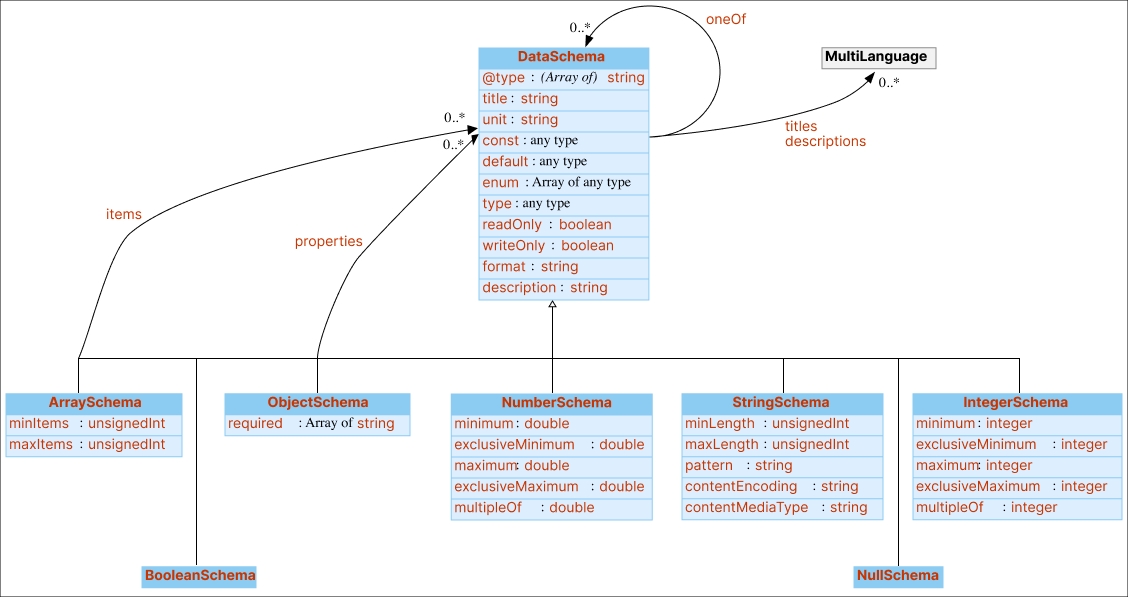
データスキーマは、データ形式に含まれるデータの
抽象的な記法である。
データスキーマ語彙定義は、JSON Schema
[JSON-SCHEMA JSON
Schema draft 7 向けの JSON Schema
[JSON-SCHEMA 7. TD Context
ExtensionsTD Context Extension を使用することで、
JSON Schema に見られる追加の用語を使用してもよい。そうでない場合、これらの
用語は TD Processors
によって意味的に無視される
(セマンティック処理の詳細については、
D. JSON-LD Context Usagehttps://www.w3.org/2019/wot/td
を参照)。
TD では、具体的なデータ形式は Forms
(5.3.4.2 Formapplication/json である場合、データスキーマは
JSON Schema プロセッサーによって直接処理できる。
それ以外の場合、Web of Things (WoT) Binding Registry
[WOT-BINDING-REGISTRY xml application/json ではなく、かつその content type に対する
マッピングが定義されていない場合、その content type に対して
データスキーマを指定することには意味がない。
次の表には、ペイロードの構造を記述するために
データスキーマを使用してもよい(MAY )
content types が含まれる。
表
9 Data
Schema を使用できる content types
形式
Content Type
JSON/CBOR
application/jsonapplication/ld+jsonapplication/senml+jsonapplication/cborapplication/senml+cbor
XML/EXI
application/xmlapplication/senml+xmlapplication/exiapplication/senml-exi
使用されるデータ形式を記述するメタデータ。
検証に使用できる。
表
10 DataSchema
レベルの語彙用語
語彙用語
説明
割り当て
型
@type
オブジェクトに semantic tags
(または型)を付与する JSON-LD キーワード
任意
string または Array of
string
title既定言語に基づく人間可読なタイトル
(例: UI 表現用のテキストを表示)を提供する。
任意
string
titles複数言語の人間可読なタイトル
(例: 異なる言語で UI 表現用のテキストを表示)を提供する。
MultiLanguage
任意
Map of MultiLanguage
description既定言語に基づく追加の(人間可読な)
情報を提供する。
任意
string
descriptions異なる言語による(人間可読な)
情報をサポートするために使用できる。
MultiLanguage
任意
Map of MultiLanguage
const定数値を提供する。
任意
任意の型
defaultデフォルト値を提供する。その値は、それが属する
データスキーマに照らして検証されるべきである
(SHOULD )。
任意
任意の型
unit
たとえば国際的な科学、工学、およびビジネスで使用される
単位情報を提供する。一意性を保つため、
unit の値はセマンティック定義を指すことが推奨される
(Semantic
Annotations セクションも参照)。
任意
string
oneOfデータが配列内で指定されたスキーマのいずれかに対して
妥当であることを保証するために使用される。これは複数の入力または出力
スキーマを記述するために使用できる。
任意
Array of DataSchema
enum配列として提供される制限された値の集合。
任意
Array of 任意の型
readOnlyproperty interaction / value が read only
(=true)かどうか(=false)を示すヒントとなるブール値。
デフォルトあり
boolean
writeOnlyproperty interaction / value が write only
(=true)かどうか(=false)を示すヒントとなるブール値。
デフォルトあり
boolean
format"date-time"、"email"、"uri" などの
format pattern に基づく検証を可能にする
(下記も参照)。
任意
string
typeJSON Schema と互換性のある JSON ベースのデータ型
(boolean、integer、number、string、object、array、null のいずれか)の割り当て。
任意
anyURI (
object、array、
string、number、
integer、boolean、または
null のいずれか)
DataSchema クラスは、次の
サブクラスを持つ:
format 文字列値は、固定された値の集合と、
[JSON-SCHEMA Servients
は、format 値を使用して、
それに応じた追加の検証を実行してもよい
(MAY )。
既知の値の集合に見つからない値が
format に割り当てられた場合、そのような検証は
成功すべきである(SHOULD )。
any type として
型付けされた語彙用語(例:
const、default)は、
JSON Schema と互換性のあるデータ型(boolean、integer、
number、string、object、array、null)に従う。
注記
format 用語は、
JSON Schema ツールによって広く実装されているわけではない。
さらに、format 用語は JSON
Schema 標準化コミュニティで議論されており、将来の JSON Schema
バージョンでは別の機構に置き換えられるか、削除される可能性がある。
Array
型のデータを記述するメタデータ。
この Subclass は、
DataSchema
インスタンス内の type に割り当てられる
値 array によって示される。
boolean 型のデータを記述するメタデータ。
この Subclass は、
DataSchema インスタンス内の type に
割り当てられる値 boolean によって示される。
number 型のデータを記述するメタデータ。
この Subclass は、
DataSchema インスタンス内の type に
割り当てられる値 number によって示される。
表
12 NumberSchema
レベルの語彙用語
語彙用語
説明
割り当て
型
minimum下限を含む下限値を表す最小数値を指定する。
関連する number または integer 型にのみ適用可能。
任意
double
exclusiveMinimum下限を含まない下限値を表す最小数値を指定する。
関連する number または integer 型にのみ適用可能。
任意
double
maximum上限を含む上限値を表す最大数値を指定する。
関連する number または integer 型にのみ適用可能。
任意
double
exclusiveMaximum上限を含まない上限値を表す最大数値を指定する。
関連する number または integer 型にのみ適用可能。
任意
double
multipleOfmultipleOf 値の数値を指定する。
値は 0 より厳密に大きくなければならない。
関連する number または integer 型にのみ適用可能。
任意
double
integer 型のデータを記述するメタデータ。
この Subclass は、
DataSchema インスタンス内の type に
割り当てられる値 integer によって示される。
表
13 IntegerSchema
レベルの語彙用語
語彙用語
説明
割り当て
型
minimum下限を含む下限値を表す最小数値を指定する。
関連する number または integer 型にのみ適用可能。
任意
integer
exclusiveMinimum下限を含まない下限値を表す最小数値を指定する。
関連する number または integer 型にのみ適用可能。
任意
integer
maximum上限を含む上限値を表す最大数値を指定する。
関連する number または integer 型にのみ適用可能。
任意
integer
exclusiveMaximum上限を含まない上限値を表す最大数値を指定する。
関連する number または integer 型にのみ適用可能。
任意
integer
multipleOfmultipleOf 値の数値を指定する。
値は 0 より厳密に大きくなければならない。
関連する number または integer 型にのみ適用可能。
任意
integer
Object 型のデータを記述するメタデータ。
この Subclass は、
DataSchema
インスタンス内の type に割り当てられる
値 object によって示される。
表
14 ObjectSchema
レベルの語彙用語
語彙用語
説明
割り当て
型
propertiesネストされたデータスキーマ定義。
任意
Map of DataSchema
requiredobject 型のどのメンバーが必須であるか、すなわち
送信されるペイロード内でどのメンバーが必須であるか
(例: invokeaction、
writeproperty の入力)、
および受信されるペイロード内でどのメンバーが
確実に配信されるか(例:
invokeaction、
readproperty の出力)を定義する
任意
Array of
string
string 型のデータを記述するメタデータ。
この Subclass は、
DataSchema インスタンス内の type に
割り当てられる値 string によって示される。
表
15 StringSchema
レベルの語彙用語
語彙用語
説明
割り当て
型
minLength文字列の最小長を指定する。
関連する string 型にのみ適用可能。
任意
unsignedInt
maxLength文字列の最大長を指定する。
関連する string 型にのみ適用可能。
任意
unsignedInt
pattern文字列値の制約を表現するための正規表現を提供する。
正規表現は [ECMA-262
任意
string
contentEncoding[RFC2045 RFC4648
任意
string (例: 7bit、
8bit、binary、
quoted-printable、
base16、base32、または
base64)
contentMediaType[RFC2046
任意
string (例:
image/png、または
audio/mpeg)
注記
文字列の長さ(すなわち
minLength および maxLength)は、
[RFC8259 ユーザーが知覚する文字 は、
複数の Unicode code points で構成されることに注意。
任意のインデックス値は、これらの grapheme
境界上にない可能性があるため、
maxLength に従った切り詰めは、文字列の見た目や
意味を変える可能性がある。
null 型のデータを記述するメタデータ。
この subclass は、DataSchema
インスタンス内の type に割り当てられる
値 null によって示される。この Subclass は、
許容される唯一の値、すなわち null のみを記述する。
null は値が存在しないことを意味しない点に
注意することが重要である。これは JavaScript の null、
Python の None、Java の
null、Ruby プログラミング言語の nil
に類似している。これは oneOf 宣言の一部として使用でき、
データが null にもなり得ることを示すために使用される。
この仕様は、W3C WoT の
Protocol
Bindings として適格なプロトコルに直接組み込まれている、
またはそれらのプロトコルとともに広く使用されている、確立された
セキュリティ機構の選択肢を提供する。現在の HTTP セキュリティ
スキームの集合は、部分的に
OpenAPI 3.0.1 に基づいている([OPENAPI Vocabulary 、および構文は
OpenAPI と多くの類似点を共有するものの、互換性はない。
一般に、セキュリティスキームが有効であるためには、
TLS や DTLS など、何らかの安全なトランスポートを必要とする。
安全なトランスポートの使用に関する要件は、この文書の
11. セキュリティの
考慮事項wot-architecture11
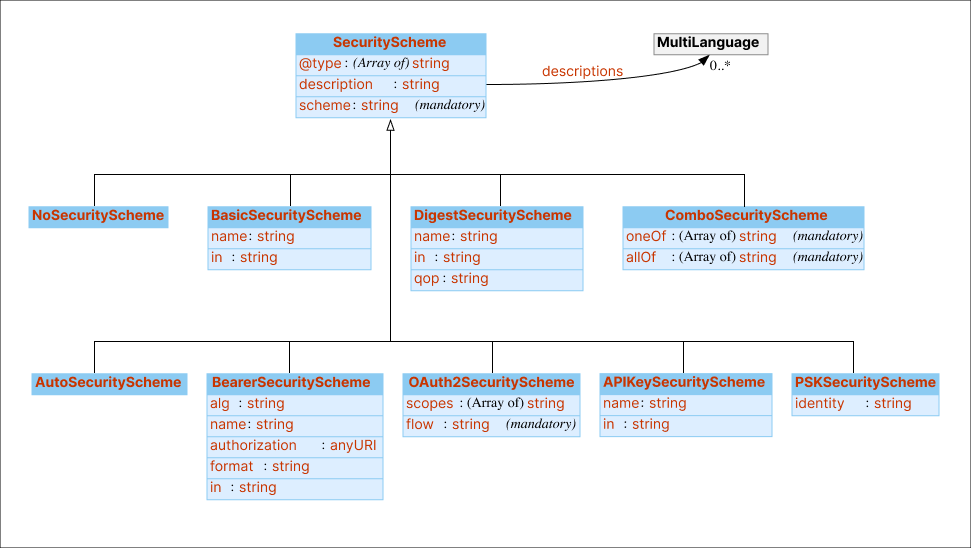
セキュリティ機構の構成を記述するメタデータ。
name
scheme に割り当てられる値は、
Thing Description に含まれる
Vocabulary 内で定義されなければならない
(MUST )。
それは § 5.
TD
Information Model で定義される標準
Vocabulary 内、または
TD Context
Extension 内のいずれかである。
すべてのセキュリティスキームについて、
アクセスを直接提供する鍵、パスワード、またはその他の機密情報は
TD に保存してはならず(MUST NOT )、
代わりに他の機構を介して out-of-band に共有および保存されるべきである。
TD の目的は、Consumer がすでに認可を持っている場合に限り、
Thing にアクセスする方法を記述することであり、その認可を付与するために
使用されることを意図していない。
TD で使用される各 security scheme オブジェクトは、
アクセスが許可される前に満たされるべき要件の集合を定義する。
その要件がすべて満たされたとき、セキュリティスキームは
satisfied であるという。場合によっては、アクセスが許可される前に
複数の security schemes からの要件を満たす必要がある。
セキュリティスキームは通常、パスワードや鍵などの追加の
認証パラメーターを要求する場合がある。この情報の場所は、
name in に関連付けられた値によって示され、
多くの場合 name に関連付けられた値と組み合わせて使用される。
in に関連付けられた値は、次の値のいずれかを取ることができる:
header:パラメーターは、プロトコルによって提供されるヘッダー内で与えられ、
ヘッダー名は name の値によって提供される。
query:パラメーターは URI に query parameter として追加され、
query parameter の名前は name によって提供される。
body:パラメーターはリクエストペイロードの body 内で提供され、
使用される data schema 要素は name によって提供される。
body
セキュリティ情報
場所の文脈で使用される場合、name の値は、
それが使用される各 interaction の入力
DataSchema のルートに相対的な JSON pointer
[RFC6901 MUST )。# で始まるべきではない。これは「純粋な」
JSON pointer である。この値は fragment identifier ではないため、
特殊文字を URL エンコードする必要もない。対象要素は、参照された object
または array schema 内の指定された場所にすでに存在していてもよいし、
存在していなくてもよい(したがってこの機構は simple types には適用できない)。
存在しない場合、それは挿入される。これにより、すべての interaction の
data schemas 内で定義を重複させる必要がなくなる。
body locator で示される
JSON pointer によって示される data schema の要素が、
示された schema 内にまだ存在しない場合、その pointer によって示される場所に
示された要素を挿入できなければならない
(MUST )。body locator で使用される
JSON pointer は、既存の array の最後の要素の後に要素を挿入する必要がある場合、
存在しない array 要素を示すために "-"
文字を使用してもよい(MAY )。body セキュリティ情報
場所によって参照(または作成)される要素は、
required であり、型 "string" でなければならない
(MUST )。name が与えられていない場合、body 全体が
セキュリティパラメーターとして使用されると仮定される。
cookie:パラメーターは name の値によって識別される
cookie に保存される。
uri:パラメーターは URI 自体に埋め込まれ、関連する interaction で
name の値によって定義される URI template variable を使用して
符号化される。これは query 機構より一般的だが、
より複雑である。
値
uri は、query が適用できない場合にのみ、
security scheme 内の name in に対して指定されるべきである
(SHOULD )。
in の値として uri を使用する security scheme の
interactions で提供される URI は、定義された変数を含む URI template
でなければならない(MUST )。
auto:場所はプロトコルの一部として決定される、または交渉される。
SecurityScheme の
in フィールドに auto の値が設定されている場合、
name フィールドは設定されるべきではない
(SHOULD
NOT )。SecurityScheme の適用は、
所定のプロトコルに対する各仕様に従う(例:
HTTP で BasicSecurityScheme を使用する場合の
[RFC8288
security scheme に複数のパラメーターが必要な場合、
各パラメーターについて security scheme 定義を繰り返し、
combo security scheme と allOf を使用して
それらを組み合わせる。場合によっては、パラメーターは実際には秘密ではないが、
ユーザーがプライバシー保護のために TD から除外したいことがある。
例として、一部のセキュリティ機構では client identifier と secret key の
両方が必要である。理論上、client identifier は公開情報であるが、
更新が難しく、追跡リスクをもたらす場合がある。このような場合、
それが TD に現れないように、追加のセキュリティパラメーターとして
提供できる。
SecurityScheme で宣言される URI 変数の名前は、
TD 内で宣言される他のすべての URI 変数と異なっていなければならない
(MUST )。
表
16 SecurityScheme
レベルの語彙用語
語彙用語
説明
割り当て
型
@type
オブジェクトに semantic tags
(または型)を付与する JSON-LD キーワード。
任意
string または Array of
string
description既定言語に基づく追加の(人間可読な)
情報を提供する。
任意
string
descriptions異なる言語による(人間可読な)
情報をサポートするために使用できる。
MultiLanguage
任意
Map of MultiLanguage
proxyこのセキュリティ構成がアクセスを提供する proxy server の URI。
与えられていない場合、対応するセキュリティ構成は endpoint 向けである。
任意
anyURI
scheme構成されるセキュリティ機構の識別。
必須
string (例:
nosec、combo、
basic、digest、
bearer、psk、
oauth2、apikey、または
auto)
SecurityScheme クラスは、次の
サブクラスを持つ:
Vocabulary Term
nosec(すなわち "scheme":
"nosec")によって識別されるセキュリティ構成であり、
リソースへアクセスするために認証やその他の機構が不要であることを示す。
用語 auto(すなわち
"scheme": "auto")によって識別される
自動認証セキュリティ構成。この scheme は、
セキュリティパラメーターが実行時に基礎となるプロトコルによって
交渉され、各プロトコルの仕様に従うことを示す
(例: HTTP 使用時の Basic Authentication については
[RFC8288
Vocabulary Term
combo(すなわち "scheme":
"combo")によって識別される、他のセキュリティスキームの組み合わせ。
この scheme の要素は、securityDefinitions で定義される
他の名前付き schemes(他の
ComboSecuritySchemeoneOf または
allOf vocabulary terms のいずれか一方だけが
含まれなければならない(MUST )。allOf と組み合わせることができる。たとえば、
一方が proxy に、もう一方が endpoint に適用される場合を除き、
異なる OAuth 2.0 flows を allOf を使用して
一般に組み合わせることはできない。security フィールドに
複数の名前付き security scheme 定義が列挙されている場合、
allOf 組み合わせと同じ意味論が適用される
(許可される組み合わせに関する同じ制限も適用される)ことに注意。
oneOf 組み合わせは、それ以外は同一の forms 上で
異なる security schemes を使用することと等価である。この意味では
oneOf scheme は本質的な機能ではないが、
そのような場合の冗長性を避けることができる。
表 17 ComboSecurityScheme
レベルの語彙用語
語彙用語
説明
割り当て
型
oneOf他の名前付き security scheme 定義を識別する
2 つ以上の文字列の配列。そのうちいずれか 1 つが満たされると
アクセスが許可される。使用のために選択できるのは 1 つだけである。
必須
Array of
string
allOf他の名前付き security scheme 定義を識別する
2 つ以上の文字列の配列。それらすべてがアクセスのために
満たされなければならない。
必須
Array of
string
暗号化されていないユーザー名とパスワードを使用する、
Vocabulary Term
basic(すなわち "scheme":
"basic")によって識別される Basic Authentication
[RFC7617
表 18 BasicSecurityScheme
レベルの語彙用語
語彙用語
説明
割り当て
型
namequery、header、cookie、または uri
パラメーターの名前。
任意
string
inセキュリティ認証情報の場所を指定する。
デフォルトあり
string (
header、query、
body、cookie、または
auto のいずれか)
Vocabulary Term
digest(すなわち "scheme":
"digest")によって識別される Digest Access Authentication
[RFC7616
表 19 DigestSecurityScheme
レベルの語彙用語
語彙用語
説明
割り当て
型
namequery、header、cookie、または uri
パラメーターの名前。
任意
string
inセキュリティ認証情報の場所を指定する。
デフォルトあり
string (
header、query、
body、cookie、または
auto のいずれか)
qop保護の品質。
デフォルトあり
string (
auth、または auth-int のいずれか)
Vocabulary Term
apikey(すなわち "scheme":
"apikey")によって識別される API key authentication
セキュリティ構成。この scheme は access token が opaque である場合、
たとえばクラウドサービスプロバイダーによって未知または独自形式の鍵が
提供される場合に使用される。その場合、その鍵は標準的な token 形式を
使用していない可能性がある。この scheme は、サービスプロバイダーによって
提供される鍵を、"in" フィールドで示される機構を使用して
サービスリクエストの一部として供給する必要があることを示す。
表 20 APIKeySecurityScheme
レベルの語彙用語
語彙用語
説明
割り当て
型
namequery、header、cookie、または uri
パラメーターの名前。
任意
string
inセキュリティ認証情報の場所を指定する。
デフォルトあり
string (
header、query、
body、cookie、
uri、または auto のいずれか)
Bearer tokens が OAuth2 から独立して使用される状況向けに、
Vocabulary Term
bearer(すなわち "scheme":
"bearer")によって識別される Bearer Token
[RFC6750 oauth2
scheme が指定されている場合、それは暗黙に含まれるため、通常この scheme も
指定する必要はない。format について、
値 jwt は [RFC7519 jws は
[RFC7797 cwt は
[RFC8392 jwe は
[RFC7516 alg の値は、これらの標準と一貫して解釈される。
Bearer token の
その他の形式およびアルゴリズムは、語彙拡張で指定してもよい
(MAY ) 。
表 21 BearerSecurityScheme
レベルの語彙用語
語彙用語
説明
割り当て
型
authorizationauthorization server の URI。
任意
anyURI
namequery、header、cookie、または uri
パラメーターの名前。
任意
string
inセキュリティ認証情報の場所を指定する。
デフォルトあり
string (
header、query、
body、cookie、または
auto のいずれか)
alg符号化、暗号化、または digest algorithm。
デフォルトあり
string (例:
ES256、または ES512-256)
formatセキュリティ認証情報の形式を指定する。
デフォルトあり
string (例: jwt、
cwt、jwe、または
jws)
Vocabulary Term
psk(すなわち "scheme": "psk")によって
識別される pre-shared key authentication セキュリティ構成。
これは、TLS-PSK [RFC4279
表
22 PSKSecurityScheme
レベルの語彙用語
語彙用語
説明
割り当て
型
identity選択または確認に使用できる情報を提供する識別子。
任意
string
[RFC6749 RFC8252 Vocabulary Term
oauth2(すなわち "scheme":
"oauth2")によって識別される。
表 23 OAuth2SecurityScheme
レベルの語彙用語
語彙用語
説明
割り当て
型
authorizationauthorization server の URI。
任意
anyURI
tokentoken server の URI。
任意
anyURI
refreshrefresh server の URI。
任意
anyURI
scopes配列として提供される authorization scope identifiers の集合。
これらは authorization server によって返される tokens 内で提供され、
client がどの resources にどのようにアクセスできるかを識別するため、
forms に関連付けられる。form に関連付けられる値は、
その form 上で有効な OAuth2SecurityScheme で定義されるものから
選択されるべきである(SHOULD )。
任意
string または Array of
string
flowAuthorization flow。
必須
string (例: code、
または client)
code
flow では、authorization および
token vocabulary terms の両方が
含まれなければならない(MUST )。
client flow では、token
vocabulary term
が含まれなければならない(MUST )。
client flow では、authorization
vocabulary term
を含めてはならない(MUST NOT )。
各 flow の必須要素は次の表に要約される:
要素
codeclient
authorization必須
省略
token必須
必須
refresh任意
任意
TD 内の割り当てが
欠落している場合、TD
Processor は、デフォルト値
定義 の表に示された
デフォルト
値 の割り当てに従わなければならない
(MUST )。
次の表は、TD
Information Model で定義されるすべての
デフォルト値 を示す。
表 31 TD 内に用語が存在しない場合に
使用される語彙用語のデフォルト値
クラス
語彙用語
デフォルト値
コメント
PropertyAffordancereadOnlyfalseこの語彙用語のデフォルト値は、
PropertyAffordance レベルの定義にのみ
適用される。DataSchema 定義などの
他の文脈では、この語彙用語は任意である。
PropertyAffordancewriteOnlyfalseこの語彙用語のデフォルト値は、
PropertyAffordance レベルの定義にのみ
適用される。DataSchema 定義などの
他の文脈では、この語彙用語は任意である。
PropertyAffordanceobservablefalse
ActionAffordancesafefalse
ActionAffordanceidempotentfalse
AdditionalExpectedResponsesuccessfalse
FormcontentTypeapplication/json
Formop
readOnly および
writeOnly が false に
設定されている場合は、要素
readproperty および
writeproperty を持つ
string の
Array 、または
readOnly が true に
設定されている場合は、要素
readproperty を持つ
string の
Array 、または
writeOnly が
true に設定されている場合は、要素
writeproperty を持つ
string の
Array 。
PropertyAffordance
のインスタンス内で定義されている場合
FormopinvokeactionActionAffordance
のインスタンス内で定義されている場合
Formop
要素
subscribeevent および
unsubscribeevent を持つ
string の
Array
EventAffordance
のインスタンス内で定義されている場合
BasicSecuritySchemeinheader
DigestSecuritySchemeinheader
DigestSecuritySchemeqopauth
APIKeySecuritySchemeinquery
BearerSecuritySchemeinheader
BearerSecuritySchemealgES256
BearerSecuritySchemeformatjwt
さらに、デフォルト値の使用には次の考慮事項が適用される:
form 内で method
(または類似のもの)が示されていない場合、
form 内で識別される
Protocol Binding
から デフォルト値
が仮定されなければならない(MUST )。
HTTP Binding の
例 を参照。
forms entry が
複数の op 値を持つ場合、その form は Consumer によって
送信可能な messages を 1 つの operation のみに制限してはならない
(MUST NOT )。"op":["readproperty",
"writeproperty"] を持つ form は
htv:methodName を含むことができない。通常、
TD Processor
は内部的に複数の op 値を個別の
forms entries に展開し、
デフォルトの仮定を使用して各 operation を具体的な protocol
request に関連付ける。address
情報(例: href)および他の metadata は、
展開後のバージョンに引き継がれる。HTTP Binding の
例 を参照。
TD が
@context で定義されていない接頭辞を持つ items を
含む場合にセマンティック処理を可能にするため、
TD Processor
は、[WOT-BINDING-REGISTRY @context を展開すべきである
(SHOULD )。
これには、TD Processor が TD 内で使用される
接頭辞を認識している必要がある。これは通常、
TD Processor が特定の protocol および
data formats の集合をサポートするよう実装されている場合に該当する。
例 4
も参照。
htv 接頭辞と
context expansion を持つ TD
Context
Expansion あり
{
"@context" : "https://www.w3.org/2022/wot/td/v1.1" ,
"id" : "urn:uuid:014139c9-b267-4db5-9c61-cc2d2bfc217d" ,
"title" : "MyLampThing" ,
"properties" : {
"status" : {
"type" : "string" ,
"forms" : [ {
"href" : "https://mylamp.example.com/status" ,
"htv:methodName" : "GET" ,
"op" : "readproperty" ,
"contentType" : "application/json"
} ]
}
}
} {
"@context" : [ "https://www.w3.org/2022/wot/td/v1.1" , {
"htv" : "http://www.w3.org/2011/http#"
} ] ,
"id" : "urn:uuid:014139c9-b267-4db5-9c61-cc2d2bfc217d" ,
"title" : "MyLampThing" ,
"properties" : {
"status" : {
"type" : "string" ,
"forms" : [ {
"href" : "https://mylamp.example.com/status" ,
"htv:methodName" : "GET" ,
"op" : "readproperty" ,
"contentType" : "application/json"
} ]
}
}
}
デフォルト値と展開機構は、順番に適用できることに注意。
たとえば、"readOnly" および
"writeOnly" が欠落していることは、
表 31 に従い、
デフォルト値 false が両方に適用されることを意味し、
その結果、"op" のデフォルト値が
["readproperty", "writeproperty"] であることを意味する。
protocol binding のデフォルト methods を使用すると、これは
"GET" および "PUT" がそれぞれ
"readproperty" および "writeproperty" に
対応することを意味する。しかし、
multiple
operations mechanism の展開 に従い、内部的に 2 つの個別の forms が作成され、
各 operation に 1 つずつ対応し、デフォルト method を示す。
その後、default context expansion
機構が適用され、@context に
htv 接頭辞の定義が追加される。
次の例は、初期 TD と、すべてのデフォルト値および展開機構を適用した後の
完全に展開された TD を示す。
複数のデフォルト値と
展開機構を持つ TD
Defaults and
Expansions あり
{
"@context" : "https://www.w3.org/2022/wot/td/v1.1" ,
"id" : "urn:uuid:014139c9-b267-4db5-9c61-cc2d2bfc217d" ,
"title" : "MyLampThing" ,
"properties" : {
"status" : {
"type" : "string" ,
"forms" : [ {
"href" : "https://mylamp.example.com/status" ,
"contentType" : "application/json"
} ]
}
}
} {
"@context" : [ "https://www.w3.org/2022/wot/td/v1.1" , {
"htv" : "http://www.w3.org/2011/http#"
} ] ,
"id" : "urn:uuid:014139c9-b267-4db5-9c61-cc2d2bfc217d" ,
"title" : "MyLampThing" ,
"properties" : {
"status" : {
"type" : "string" ,
"readOnly" : false ,
"writeOnly" : false ,
"forms" : [
{
"href" : "https://mylamp.example.com/status" ,
"htv:methodName" : "GET" ,
"op" : "readproperty" ,
"contentType" : "application/json"
} ,
{
"href" : "https://mylamp.example.com/status" ,
"htv:methodName" : "PUT" ,
"op" : "writeproperty" ,
"contentType" : "application/json"
}
]
}
}
}
WoT Thing Descriptions は Things を表し、
5. TD
情報モデルTD
Information Model によって定義される
Class
Thing のインスタンスのシリアル化である、
Things のための
JSON ベースの表現形式を定義する。
TD Processor は、
6.1 JSON 型へのマッピング6.3 情報モデルの
シリアル化Thing
Descriptions を JSON 形式 [RFC8259 Thing Descriptions を
デシリアル化できなければならない(MUST )。
TD
Information Model の JSON シリアル化は、
セマンティック評価を簡素化するため、JSON-LD 1.1
[json-ld11 D. JSON-LD Context Usagehttps://www.w3.org/2019/wot/td を参照)。
相互運用可能な国際化をサポートするため、
TD は、
open ecosystems 向けに RFC8259 [RFC8259 MUST )。
要約すると、これは次を要求する:
TD は UTF-8
[RFC3629 MUST )。 実装は、
TD 文書の先頭に byte order mark (U+FEFF) を追加してはならない
(MUST NOT )。 TD Processors は、
byte order mark の存在をエラーとして扱うのではなく、
無視してもよい(MAY )。
TD
Information Model は、モデルの Objects と JSON 型との間に
容易なマッピングが存在するように構築されている。すべての
Class
インスタンスは JSON
object にマップされ、Class インスタンスの各 name-value pair は
JSON object のメンバーとなる。
5.3
Class DefinitionsSimple
Type
(すなわち string、anyURI、
dateTime、integer、
unsignedInt、double、および
boolean)は、以下に列挙する規則に従って、
primitive JSON type(string、number、boolean)にマップされる。
これらの規則は name-value pair 内の値に適用される:
string または anyURI 型の値は、
JSON strings としてシリアル化されなければならない
(MUST )。
dateTime 型の値は、
[RFC3339 MUST )。
例としては 2019-05-24T13:12:45Z
および 2015-07-11T09:32:26+08:00 がある。
dateTime 型の値は、
offset ではなく、UTC time zone を表す literal Z を
使用すべきである(SHOULD )。
integer または unsignedInt 型の値は、
fraction または exponent part を持たない JSON numbers として
シリアル化されなければならない(MUST )。
double 型の値は、JSON number として
シリアル化されなければならない(MUST )。
boolean 型の値は、JSON boolean として
シリアル化されなければならない(MUST )。
TD
Information Model のすべての complex type
(すなわち、
Arrays 、Maps 、および
Class
インスタンス)は、
以下に列挙する規則に従って、structured JSON type(array および object)にマップされる:
Array 型の値は、
pair の numeric name によって順序付けられた
name-value pair の各値を JSON array の要素として、
JSON array としてシリアル化されなければならない
(MUST )。
Map
型の値は、
各 name-value pair を JSON object のメンバーとして、
JSON object としてシリアル化されなければならない
(MUST )。
Class インスタンスは、
6.3 情報モデルの
シリアル化MUST )。
Thing Description シリアル化は、5.4
デフォルト値定義Default Values が
定義されている Vocabulary Term を
省略してもよい。
次の例は、例 1 の TD インスタンスを、
Default Values
を持つメンバーも含めるための checkbox
(= checkbox checked)とともに示す。これらのメンバーは、
TD シリアル化を簡略化するために省略できる(= checkbox
unchecked)。TD
Processor は、これらの省略されたメンバーを、所定の
Default Value で
明示的に存在している場合と同一に解釈することに注意。
省略可能な Default Values を持つ TD
Default
Values あり
{
"@context" : "https://www.w3.org/ns/wot-next/td" ,
"id" : "urn:uuid:014139c9-b267-4db5-9c61-cc2d2bfc217d" ,
"title" : "MyLampThing" ,
"securityDefinitions" : {
"basic_sc" : {
"scheme" : "basic"
}
} ,
"security" : "basic_sc" ,
"properties" : {
"status" : {
"type" : "string" ,
"forms" : [ {
"href" : "https://mylamp.example.com/status"
} ]
}
} ,
"actions" : {
"toggle" : {
"forms" : [ {
"href" : "https://mylamp.example.com/toggle"
} ]
}
} ,
"events" : {
"overheating" : {
"data" : {
"type" : "string"
} ,
"forms" : [ {
"href" : "https://mylamp.example.com/oh" ,
"subprotocol" : "longpoll"
} ]
}
}
} {
"@context" : "https://www.w3.org/ns/wot-next/td" ,
"id" : "urn:uuid:014139c9-b267-4db5-9c61-cc2d2bfc217d" ,
"title" : "MyLampThing" ,
"securityDefinitions" : {
"basic_sc" : {
"scheme" : "basic" ,
"in" : "header"
}
} ,
"security" : "basic_sc" ,
"properties" : {
"status" : {
"type" : "string" ,
"readOnly" : false ,
"writeOnly" : false ,
"observable" : false ,
"forms" : [ {
"op" : [
"readproperty" ,
"writeproperty"
] ,
"href" : "https://mylamp.example.com/status" ,
"contentType" : "application/json"
} ]
}
} ,
"actions" : {
"toggle" : {
"safe" : false ,
"idempotent" : false ,
"forms" : [ {
"op" : "invokeaction" ,
"href" : "https://mylamp.example.com/toggle" ,
"contentType" : "application/json"
} ]
}
} ,
"events" : {
"overheating" : {
"data" : {
"type" : "string" ,
"readOnly" : false ,
"writeOnly" : false } ,
"forms" : [ {
"op" : "subscribeevent" ,
"href" : "https://mylamp.example.com/oh" ,
"contentType" : "application/json" ,
"subprotocol" : "longpoll"
} ]
}
}
}
使用される Protocol
Binding によっては、追加の protocol-specific
Vocabulary Terms が
適用される場合があることに注意。それらには関連付けられた
Default Values も
あり得るため、このサブセクションで説明したように省略することもできる。
詳細については、8.1.1 Protocol
Bindings
Thing Description は、型
ThingObject
をルートとするデータ構造である。さらに、Thing Description の JSON
シリアル化は JSON object であり、
TD
Information Model から構築される構文木のルートである。
TD Serialization のルート
要素は、@context という名前のメンバーを含み、
その値が文字列型、または
https://www.w3.org/ns/wot-next/td と等しい、もしくはそれを含む
array 型である JSON object でなければならない(MUST )。
一般に、この URI は、この仕様によって定義される TD
表現形式のバージョンを識別するために使用される。
JSON-LD 処理 [json-ld11 @context は
TD Context Extensions
を示す(詳細は 7. TD Context
Extensions
{
"@context" : "https://www.w3.org/ns/wot-next/td" ,
}
Thing の Signature 内の
Vocabulary Term を名前とする、
Thing のインスタンスのすべての name-value pairs は、
ルートオブジェクトの JSON members としてシリアル化されなければならない
(MUST )。
すべての必須および任意のメンバーを含む、
シリアル化されたルートオブジェクトの TD snippet を以下に示す:
{
"@context" : "https://www.w3.org/ns/wot-next/td" ,
"@type" : "Thing" ,
"id" : "urn:uuid:1b37933b-3212-4dad-9c2c-74c6042c3e2b" ,
"title" : "MyThing" ,
"titles" : {},
"description" : "Human readable information." ,
"descriptions" : {},
"support" : "mailto:support@example.com" ,
"version" : {},
"created" : "2018-11-14T19:10:23.824Z" ,
"modified" : "2019-06-01T09:12:43.124Z" ,
"securityDefinitions" : {},
"security" : ,
"base" : "https://servient.example.com/" ,
"properties" : {},
"actions" : {},
"events" : {},
"links" : [...],
"forms" : [...]
}
Class
Thing のインスタンス内で
version、
securityDefinitions、
descriptions、schemaDefinitions、
uriVariables、properties、
actions、および events に割り当てられる
すべての値は、JSON objects としてシリアル化されなければならない
(MUST )。
Class Thing
のインスタンス内で links および
forms に割り当てられるすべての値は、それぞれ
6.3.8
links6.3.9
formsMUST )。
Class Thing
のインスタンス内で security に割り当てられる値は、
JSON string または、その要素が JSON strings である JSON array として
シリアル化されなければならない(MUST )。
title および
description という名前の JSON members は、
TD 文書内で人間可読メタデータを提供するために使用される。
これらは、TD 文書を調べる開発者向けのコメントとして、または
user interface 向けの display texts として使用できる。
5.3.1.1
Thing@context 内の
@language に割り当てられた値によって定義され、
必要に応じて script subtag とともに、base text direction を決定するために
使用できる。ただし、
人間可読テキストを解釈する際、各人間可読な
string value は独立して処理されなければならない
(MUST )。 言い換えると、
TD Processor
は、ある string から別の string へ方向の変更を引き継いだり、
TD 内の別の場所にある他の string から、ある string の方向を
推論したりすることはできない。
title および
description を使用する TD snippet を以下に示す。default
language は、@context array 内の JSON object の
@language member の定義を通じて en に設定されている。
{
"@context" : [
"https://www.w3.org/ns/wot-next/td" ,
{ "@language" : "en" }
],
"title" : "MyThing" ,
"description" : "Human readable information." ,
"properties" : {
"on" : {
"title" : "On/Off" ,
"type" : "boolean" ,
"forms" : [...]
},
"status" : {
"title" : "Status" ,
"type" : "object" ,
"forms" : [...]
}
},
}
Strings on the Web [STRING-META base
direction を決定するために metadata を使用することを推奨している。
Thing Description 形式は
JSON-LD 1.1
[json-ld11 @direction は、string values
"ltr"、"rtl" および null value
null とともに、TD 文書全体の人間可読 strings の
default text direction を示すために @context 内で
使用してもよい(MAY )。
@direction などの metadata が存在しない場合、
TD Consumers は fallback として
first-strong detection を使用すべきである
(SHOULD )。
MultiLanguage
Map
について、
TD Consumers は、個々の strings の language tag から
base
direction を推論してもよい(MAY )。
これらは、TD で提供される情報に基づいて TD Consumers が実装できる
次の手順に要約できる。
ファイルレベルのメタデータ:
@context に見つかる
@direction の値を使用する。
言語から推測:
@language の値を使用し、その後テキストの方向を推測する
First-strong: string 内の最初の
強い方向性を持つ文字を使用する。これは HTML
attributes で dir=auto を使用することと等価である。
注記
現在の仕様バージョンでは、string 固有の direction
metadata は不可能であることに注意。Working Group はそれを可能にする
機構に取り組んでいる。その後は、それが TD
Consumers にとって text direction を扱う推奨方法となる。
さらに、以下の例は
@direction および @language
terms の使用を示している。より詳細な情報については
[json-ld11 string-meta
{
"@context" : [
"https://www.w3.org/ns/wot-next/td" ,
{
"@language" : "ar-EG" ,
"@direction" : "rtl"
}
],
"title" : "شيء يخصني يقيس درجة الحرارة" ,
"description" : "شيء يقيس درجة الحرارة و يظهر حالته" ,
"properties" : {
"temp" : {
"title" : "درجة الحرارة" ,
"type" : "boolean" ,
"forms" : [...]
},
"status" : {
"title" : "حالة" ,
"type" : "object" ,
"forms" : [...]
}
},
}
titles および
descriptions という名前の JSON members は、
単一の TD 文書内で複数言語の人間可読メタデータを提供するために
TD 文書内で使用される。
MultiLanguage Map のすべての name-value
pairs は JSON object の members としてシリアル化されなければならず
(MUST )、その name は
[BCP47
W3C I18N Glossary
詳細は 5.3.1.7
MultiLanguageTD 文書内のすべての
MultiLanguage object は、同じ language members の集合を
含むべきである(SHOULD )。
異なるレベルで titles および
descriptions を使用する TD snippet を以下に示す:
{
"@context" : "https://www.w3.org/ns/wot-next/td" ,
"title" : "MyThing" ,
"titles" : {
"en" : "MyThing" ,
"de" : "MeinDing" ,
"ja" : "私の物" ,
"zh-Hans" : "我的东西" ,
"zh-Hant" : "我的東西"
},
"descriptions" : {
"en" : "Human readable information." ,
"de" : "Menschenlesbare Informationen." ,
"ja" : "人間が読むことができる情報" ,
"zh-Hans" : "人们可阅读的信息" ,
"zh-Hant" : "人們可閱讀的資訊"
},
"properties" : {
"on" : {
"titles" : {
"en" : "On/Off" ,
"de" : "An/Aus" ,
"ja" : "オンオフ" ,
"zh-Hans" : "开关" ,
"zh-Hant" : "開關" },
"type" : "boolean" ,
"forms" : [...]
},
"status" : {
"titles" : {
"en" : "Status" ,
"de" : "Zustand" ,
"ja" : "状態" ,
"zh-Hans" : "状态" ,
"zh-Hant" : "狀態" },
"type" : "object" ,
"forms" : [...]
}
},
}
TD instances は、
title および description の使用を、
titles および descriptions と
組み合わせることもできる。
title と
titles、または description と
descriptions が同じ JSON object 内に存在する場合、
title および
description の値は default text と見なしてもよい
(MAY )。
title と titles、または
description と descriptions が
TD 文書内に存在する場合、各 title および
description member には、それぞれ対応する
titles および descriptions member が
あるべきである(SHOULD )。
default text の言語は default language によって示され、
これは通常 Thing Description instance の作成者によって設定される。
{
"@context" : [
"https://www.w3.org/ns/wot-next/td" ,
{ "@language" : "de" }
],
"title" : "MeinDing" ,
"titles" : {
"en" : "MyThing" ,
"de" : "MeinDing" ,
"ja" : "私の物" ,
"zh-Hans" : "我的东西" ,
"zh-Hant" : "我的東西"
},
"description" : "Menschenlesbare Informationen." ,
"descriptions" : {
"en" : "Human readable information." ,
"de" : "Menschenlesbare Informationen." ,
"ja" : "人間が読むことができる情報" ,
"zh-Hans" : "人们可阅读的信息" ,
"zh-Hant" : "人們可閱讀的資訊"
},
"properties" : {
"on" : {
"title" : "An/Aus" ,
"titles" : {
"en" : "On/Off" ,
"de" : "An/Aus" ,
"ja" : "オンオフ" ,
"zh-Hans" : "开关" ,
"zh-Hant" : "開關" },
"type" : "boolean" ,
"forms" : [...]
},
"status" : {
"title" : "Zustand" ,
"titles" : {
"en" : "Status" ,
"de" : "Zustand" ,
"ja" : "状態" ,
"zh-Hans" : "状态" ,
"zh-Hant" : "狀態" },
"type" : "object" ,
"forms" : [...]
}
},
}
default language を設定する別の可能性は、
HTTP の Accept-Language header field などの
language negotiation mechanism を通じることである。
default language が交渉された場合、
negotiation の結果と、返された content の対応する default language を
示すために、@language member が存在しなければならない
(MUST )。
default
language が正常に
交渉された場合、TD documents は、
titles および descriptions
members 内の MultiLanguage objects よりも優先して、
members title および description に対する
適切に一致する値を含むべきである(SHOULD )。
ただし、
Things はそのような動的に生成される TDs をサポートしないこと、または
language negotiation をサポートしないことを選択してもよい
(たとえば resource constraints のため)(MAY )。
TDs 内の strings が HTML rendering context で表示される保証はない。
実際、11.5 Script
Injection
VersionInfo のインスタンスのすべての
name-value pairs のうち、その name が
VersionInfo の
Signature に含まれる
Vocabulary Term
であるものは、Vocabulary Term を
name とする JSON members としてシリアル化されなければならない
(MUST )。
version information object の TD snippet を以下に示す:
{
"version" : { "instance" : "1.2.1" } ,
}
version member は、
TD Context Extensions に基づく、
application 固有および/または device 固有の追加 version
information のための container として意図されている。詳細は
7.1 Semantic
Annotations
Thing インスタンスでは、
securityDefinitions に割り当てられる値は、
SecurityScheme のインスタンスの
Map
である。
SecurityScheme インスタンスの
Map
のすべての name-value pairs は、
Map を
シリアル化した結果の JSON object の members として
シリアル化されなければならず(MUST )、
pair の name は JSON string としてシリアル化されなければならず
(MUST )、
pair の value、すなわち
SecurityScheme のインスタンスは JSON object として
シリアル化されなければならない(MUST )。
SecurityScheme の
Subclasses の 1 つの
インスタンスのすべての name-value pairs のうち、その name が、その
Subclass の
Signature または
SecurityScheme の
Signature に含まれる
Vocabulary Term であるものは、
SecurityScheme
Subclass のインスタンスを
シリアル化した結果の JSON object の members として、
Vocabulary Term を
name としてシリアル化されなければならない
(MUST )。
次の TD snippet は、header 内で basic username/password
authentication を指定する単純な security
configuration を示す。in に与えられている値は、実際には
Default Value
(header)であり、省略できる。
named security configuration(basic_sc)は
securityDefinitions map 内で与えられる。この例では、
その定義は、その JSON name を security
member に含めることによって有効化される。
{
"securityDefinitions" : {
"basic_sc" : {
"scheme" : "basic" ,
"in" : "header"
}
} ,
"security" : "basic_sc" ,
}
TD 内の security configuration は必須である。
少なくとも 1 つの security definition は、
Thing level
(すなわち TD root object)で security member を通じて
有効化されなければならない(MUST )。
この configuration は、Thing と interaction するために必要な
default security mechanism と見なすことができる。
Security definitions は、
form objects 内に security member を含めることによって
form elements のレベルでも有効化してもよく
(MAY )、これは
Thing
level で有効化されたすべての定義を上書きする
(すなわち完全に置き換える)。
nosec security scheme は、security が不要な場合のために
提供される。Thing の最小 security
configuration は、次の例に示すように、
Thing level での
nosec security scheme の有効化である:
{
"@context" : "https://www.w3.org/ns/wot-next/td" ,
"id" : "urn:uuid:e9ecb6ad-cd4c-481b-96ce-5b4c57ddb844" ,
"title" : "MyThing" ,
"description" : "Human readable information." ,
"support" : "https://servient.example.com/contact" ,
"securityDefinitions" : { "nosec_sc" : { "scheme" : "nosec" } } ,
"security" : "nosec_sc" ,
"properties" : { } ,
"actions" : { } ,
"events" : { } ,
"links" : [ ]
}
より複雑な例として、すべての
Interaction
Affordances が basic authentication を必要とするが、
1 つだけ authentication が不要な
Thing があるとする。
status Property と toggle
Action では、basic authentication が必要であり、
Thing level で定義される。
しかし overheating Event では authentication は不要であり、
したがって security configuration は form level で上書きされる。
{
"securityDefinitions" : {
"basic_sc" : { "scheme" : "basic" } ,
"nosec_sc" : { "scheme" : "nosec" }
} ,
"security" : "basic_sc" ,
"properties" : {
"status" : {
"forms" : [ {
"href" : "https://mylamp.example.com/status"
} ]
}
} ,
"actions" : {
"toggle" : {
"forms" : [ {
"href" : "https://mylamp.example.com/toggle"
} ]
}
} ,
"events" : {
"overheating" : {
"forms" : [ {
"href" : "https://mylamp.example.com/oh" ,
"security" : "nosec_sc"
} ]
}
}
}
TDs は security schemes の組み合わせも指定できる。
以下は、proxy 上の digest authentication と、
Thing 上の bearer token
authentication を組み合わせた TD snippet である。
digest scheme では、in の
Default Value
(すなわち header)は省略されているが、依然として適用される。
username/password や tokens などの対応する private security
configuration は、正常に interaction するために
Consumer 内で
構成する必要があることに注意。複数の security definitions を
有効化する場合、security member は array になる。
{
"securityDefinitions" : {
"proxy_sc" : {
"scheme" : "digest" ,
"proxy" : "https://portal.example.com/"
} ,
"bearer_sc" : {
"scheme" : "bearer" ,
"in" : "header" ,
"format" : "jwt" ,
"alg" : "ES256" ,
"authorization" : "https://servient.example.com:8443/"
}
} ,
"security" : [ "proxy_sc" , "bearer_sc" ] ,
}
ただし、
security element 内で security schemes を組み合わせるために
複数要素の array を使用することは現在 deprecated であり、
代わりに ComboSecuritySchemeSHOULD )。
次の例は上記と完全に等価であり、これを示している:
{
"securityDefinitions" : {
"proxy_sc" : {
"scheme" : "digest" ,
"proxy" : "https://portal.example.com/"
} ,
"bearer_sc" : {
"scheme" : "bearer" ,
"in" : "header" ,
"format" : "jwt" ,
"alg" : "ES256" ,
"authorization" : "https://servient.example.com:8443/"
} ,
"combo_sc" : {
"scheme" : "combo" ,
"allOf" : [ "proxy_sc" , "bearer_sc" ]
}
} ,
"security" : "combo_sc" ,
}
この場合の冗長性、たとえば form elements の詳細の繰り返しを
避けるために、代わりに oneOf を持つ
ComboSecurityScheme
{
"securityDefinitions" : {
"basic_sc" : { "scheme" : "basic" } ,
"digest_sc" : { "scheme" : "digest" } ,
"bearer_sc" : { "scheme" : "bearer" } ,
"combo_sc" : {
"scheme" : "combo" ,
"oneOf" : [ "basic_sc" , "digest_sc" , "bearer_sc" ]
}
} ,
"security" : "combo_sc" ,
"properties" : {
"status" : {
"forms" : [ {
"href" : "https://mylamp.example.com/status"
} ]
}
} ,
}
別のより複雑な例として、OAuth 2.0 は scopes を使用する。
これらは tokens 内に現れることがある identifiers であり、その resource
(または W3C WoT の場合は
Interaction
Affordance )へのアクセスを許可するために、
resource 内の対応する identifiers と一致しなければならない。
たとえば以下では、status Property は、
scope limited を含む bearer
tokens を使用する Consumers によって
read できるが、configure Action は
special scope を含む token によってのみ invoke できる。
Scopes は roles と同一ではないが、多くの場合それらに関連付けられる。
たとえば、administrative role の者だけが "special"
interactions を実行する認可を持つかもしれない。Tokens は複数の scope を
持つことができ、dedicated web services によって users に発行される。
この例では、administrator は limited と
special の両方の scopes を持つ tokens を発行され得る一方で、
ordinary users には limited scope を持つ tokens が
提供され得る。
{
"securityDefinitions" : {
"oauth2_sc" : {
"scheme" : "oauth2" ,
"flow" : "client" ,
"token" : "https://example.com/token" ,
"scopes" : [ "limited" , "special" ]
}
} ,
"security" : "oauth2_sc" ,
"properties" : {
"status" : {
"forms" : [ {
"href" : "https://scopes.example.com/status" ,
"scopes" : [ "limited" ]
} ]
}
} ,
"actions" : {
"configure" : {
"forms" : [ {
"href" : "https://scopes.example.com/configure" ,
"scopes" : [ "special" ]
} ]
}
} ,
}
Thing は onboarding process を必要とすることがあり、その結果、
Consumer が Thing と interaction するために API key を必要とする。
この API key は、API key scheme が指定するように、異なる方法で
Thing への request に含めることができる。以下は、
HTTPS request を送信するときに Consumer によって URI 内の API key が
置き換えられるべき URI template として、これを使用する方法の例である。
{
"securityDefinitions" : {
"apikey_key" : {
"scheme" : "apikey" ,
"in" : "uri" ,
"name" : "adminKey"
}
} ,
"security" : "apikey_key" ,
"properties" : {
"status" : {
"forms" : [ {
"href" : "https://example.com/{adminKey}/status" ,
} ]
}
} ,
}
上に示した URI templates の例の使用に加えて、
ComboSecuritySchemeAPIKeySecuritySchemein
location specifier に uri 値を使用して、
2 つの URI variables を宣言する。これらは、security scheme が有効な
Form 内の href で使用できる
(実際には、使用しなければならない)。例は次のとおり:
{
"securityDefinitions" : {
"apikey_key" : {
"scheme" : "apikey" ,
"in" : "uri" ,
"name" : "secKey"
} ,
"apikey_id" : {
"scheme" : "apikey" ,
"in" : "uri" ,
"name" : "secClientID"
} ,
"apikey_combo" : {
"scheme" : "combo" ,
"allOf" : [ "apikey_key" , "apikey_id" ]
}
} ,
"security" : "apikey_combo" ,
"properties" : {
"status" : {
"forms" : [ {
"href" : "https://example.com/{secClientID}/status/{secKey}" ,
} ]
}
} ,
}
この例には示されていないが、uriVariables を使用して
追加の URI template variables を宣言し、それらを同じ URI template に
含めることは合法である。ただし、その names は security schemes で宣言されたものと
衝突してはならない。上の例のように、security schemes で宣言される
URI variables に特定の prefix を使用すると、name
conflicts を避けやすくなる。
Body 内の API Key: 一部のシステムでは、security parameters が
payload とともに含まれる場合もある。たとえば、あるシステムがすべての
payload に対して、auth という名前の member を含む
JSON object であることを要求し、その value が access key を含む
key という member を持つ object であるとする。
ただし、interaction によっては、JSON object の他の elements が異なることがある。
この状況は、body security information location を使用して扱うことができる。
この location では、name parameter は実際には、それが結び付けられた
各 interaction の DataSchema のルートを基準に評価される
JSON pointer であり、他の点で異なる payloads とともに使用できることに注意。
例として、brightness と color を設定する property と、オンおよびオフにする
2 つの別々の actions を持つ light がある。これらの actions の JSON
payloads は異なるが、/auth/key element は同じ相対位置に
現れるため、単一の JSON pointer を使用できる。注記: security key が
一貫しない異なる locations に現れる場合は、複数の security scheme definitions を
使用する必要がある。
{
"securityDefinitions" : {
"apikey_body" : {
"scheme" : "apikey" ,
"in" : "body" ,
"name" : "/auth/key"
}
} ,
"security" : "apikey_body" ,
"properties" : {
"color" : {
"type" : "object" ,
"properties" : {
"brightness" : {
"type" : "number" ,
} ,
"rgb" : {
"type" : "array" ,
} ,
"auth" : {
"type" : "object" ,
"properties" : {
"key" : {
"type" : "string"
}
} ,
"required" : [ "key" ]
}
} ,
"required" : [ "brightness" , "rgb" , "auth" ] ,
"forms" : [ {
"href" : "https://example.com/color" ,
} ]
}
} ,
"action" : {
"on" : {
"input" : {
"auth" : {
"type" : "object" ,
"properties" : {
"key" : {
"type" : "string"
}
} ,
"required" : [ "key" ]
}
} ,
"required" : [ "auth" ] ,
"forms" : [ {
"href" : "https://example.com/on" ,
} ]
} ,
"off" : {
"input" : {
"auth" : {
"type" : "object" ,
"properties" : {
"key" : {
"type" : "string"
}
} ,
"required" : [ "key" ]
}
} ,
"required" : [ "auth" ] ,
"forms" : [ {
"href" : "https://example.com/off" ,
} ]
}
} ,
} しかし、すべての data schema に security information を追加するのは
かなり煩雑で冗長である。
body location 内の JSON pointer によって参照される location は、
それが存在しない場合に自動的に挿入されるという機能を使用することで、
この例を簡略化することができる。この場合、上記の例は
次のように簡略化できる。実際には、actions on および
off について、security information だけを保持する
data schema が実質的に作成 されることに注意。
{
"securityDefinitions" : {
"apikey_body" : {
"scheme" : "apikey" ,
"in" : "body" ,
"name" : "/auth/key"
}
} ,
"security" : "apikey_body" ,
"properties" : {
"color" : {
"type" : "object" ,
"properties" : {
"brightness" : {
"type" : "number" ,
} ,
"rgb" : {
"type" : "array" ,
}
} ,
"required" : [ "brightness" , "rgb" ] ,
"forms" : [ {
"href" : "https://example.com/color" ,
} ]
}
} ,
"action" : {
"on" : {
"required" : [ "auth" ] ,
"forms" : [ {
"href" : "https://example.com/on" ,
} ]
} ,
"off" : {
"forms" : [ {
"href" : "https://example.com/off" ,
} ]
}
} ,
}
Thing インスタンス内で
properties に割り当てられる値は、
PropertyAffordance のインスタンスの
Map
である。すべての name-value
pairs
of a Map
of
PropertyAffordance instances は、
Map
をシリアル化した結果の
JSON object の members としてシリアル化されなければならず
(MUST )、pair の name は JSON string として
シリアル化されなければならず(MUST )、
pair の value、すなわち
PropertyAffordance のインスタンスは JSON
object としてシリアル化されなければならない(MUST )。
PropertyAffordance のインスタンスのすべての name-value pairs のうち、
その name が
PropertyAffordance、
InteractionAffordance、または
DataSchema の
Signatures の(いずれかに)含まれる
Vocabulary Term であるものは、
PropertyAffordance インスタンスをシリアル化した結果の
JSON object の members として、Vocabulary Term を
name としてシリアル化されなければならない(MUST )。
DataSchema6.3.10 Data
Schemas
PropertyAffordance のインスタンス内で
forms に割り当てられる値は、6.3.9
formsMUST )。
2 つの Property affordances の snippet を
以下に示す:
例
26 : Property serializations
のサンプル
{
"properties" : {
"on" : {
"type" : "boolean" ,
"forms" : [...]
},
"status" : {
"type" : "object" ,
"properties" : {
"brightness" : {
"type" : "number" ,
"minimum" : 0.0 ,
"maximum" : 100.0
},
"rgb" : {
"type" : "array" ,
"items" : {
"type" : "number" ,
"minimum" : 0 ,
"maximum" : 255
},
"minItems" : 3 ,
"maxItems" : 3
}
},
"required" : ["brightness" , "rgb" ],
"forms" : [...]
}
},
}
Thing インスタンス内で
actions に割り当てられる値は、
ActionAffordance のインスタンスの
Map
である。
ActionAffordance インスタンスの
Map の
すべての name-value pairs は、
Map
をシリアル化した結果の
JSON object の members としてシリアル化されなければならず
(MUST )、pair の name は JSON string として
シリアル化されなければならず(MUST )、
pair の value、すなわち
ActionAffordance のインスタンスは JSON
object としてシリアル化されなければならない(MUST )。
ActionAffordance のインスタンスのすべての
name-value pairs のうち、その name が
ActionAffordance または
InteractionAffordance の
Signatures の(いずれかに)含まれる
Vocabulary Term であるものは、
ActionAffordance インスタンスをシリアル化した結果の JSON
object の members として、Vocabulary Term を
name としてシリアル化されなければならない(MUST )。
ActionAffordance のインスタンス内で
input および output に割り当てられる値は、
JSON objects としてシリアル化されなければならない(MUST )。
それらは Class
DataSchema6.3.10 Data
Schemas
ActionAffordance のインスタンス内で forms に
割り当てられる値は、6.3.9
formsMUST )。
Action affordance の TD snippet を以下に示す:
例
27 : Action serialization
のサンプル
{
// ...
"actions": {
"fade": {
"title": "Fade in/out" ,
"description" : "Smooth fade in and out animation." ,
"input" : {
"type": "object" ,
"properties" : {
"from ": {
"type": "integer" ,
"minimum" : 0 ,
"maximum" : 100
},
"to ": {
"type": "integer" ,
"minimum" : 0 ,
"maximum" : 100
},
"duration": {"type": "number" }
},
"required": ["to" ,"duration" ]
},
"output": {"type": "string" },
"forms": [...]
}
},
// ...
}
Thing インスタンス内で
events に割り当てられる値は、
EventAffordance のインスタンスの map である。
EventAffordance インスタンスの
Map の
すべての name-value pairs は、
Map
をシリアル化した結果の
JSON object の members としてシリアル化されなければならず
(MUST )、pair の name は JSON string として
シリアル化されなければならず(MUST )、
pair の value、すなわち
EventAffordance のインスタンスは JSON object として
シリアル化されなければならない(MUST )。
EventAffordance のインスタンスのすべての
name-value pairs のうち、その name が
EventAffordance または
InteractionAffordance の
Signatures の(いずれかに)含まれる
Vocabulary Term であるものは、
EventAffordance インスタンスをシリアル化した結果の
JSON object の members として、Vocabulary Term を
name としてシリアル化されなければならない(MUST )。
EventAffordance のインスタンス内で
subscription、data、および
cancellation に割り当てられる値は、
JSON objects としてシリアル化されなければならない(MUST )。
それらは
Class DataSchema6.3.10
Data
Schemas
EventAffordance のインスタンス内で
forms に割り当てられる値は、6.3.9 formsMUST )。
Event object の TD snippet を以下に示す:
例
28 : Event serialization
のサンプル
{
"events" : {
"overheated" : {
"data" : {
"type" : "string"
},
"forms" : [...]
}
},
}
Event affordances は、既存の(例: WebSub
[websub subscription および
cancellation は、望ましい mechanism に従って定義できる。
さらなる詳細は
[WOT-BINDING-TEMPLATES A.3 Webhook Event
Examplesubscription および
cancellation をどのように使用できるかを示している。
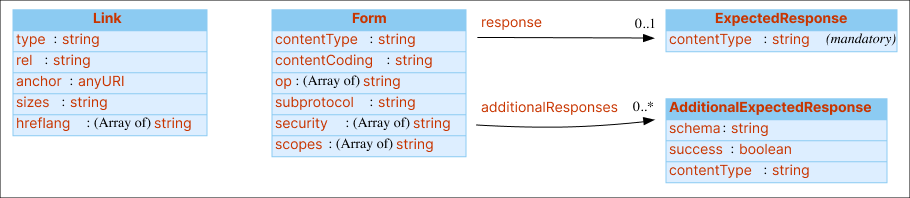
Link のインスタンスのすべての
name-value pairs のうち、その name が
Link の
Signature に含まれる
Vocabulary Term であるものは、
Link インスタンスをシリアル化した結果の JSON object の
members として、Vocabulary Term を
name としてシリアル化されなければならない(MUST )。
5.3.4.1
Link
基礎となる unit(例: ランプ)を制御する
Thing (例:
controller)を
指す reference を提供できる。このためには
controlledBy を使用できる:
例
29 : Link serialization
のサンプル
{
"links" : [ {
"rel" : "controlledBy" ,
"href" : "https://servient.example.com/things/lampController" ,
"type" : "application/td+json"
} ]
}
Thing の
developer documentation を
指すには、値
service-doc を使用できる:
例
30 : developer documentation
への Link
{
"links" : [ {
"rel" : "service-doc" ,
"href" : "https://example.com/howTo" ,
"type" : "application/pdf" ,
"hreflang" : "en"
} ]
}
上位の Thing は Things の group を収集し、
item 値を使用してそれらを参照できる:
例
31 : Electric
drive が 2 つの motors を含む。
{
"title" : "Electric Drive" ,
"links" : [ {
"rel" : "item" ,
"href" : "coaps://motor1.example.com" ,
"type" : " application/td+json"
} ,
{
"rel" : "item" ,
"href" : "coaps://motor2.example.com" ,
"type" : " application/td+json"
} ]
}
Thing は、それが収集されている group を
collection 値で参照する:
例 32 :
Electric motor は electric drive
collection の member である。
{
"title" : "Electric Motor 1" ,
"base" : "coaps://motor1.example.com" ,
"links" : [ {
"rel" : "collection" ,
"href" : "coaps://drive.example.com" ,
"type" : " application/td+json"
} ]
}
Form のインスタンスのすべての
name-value pairs のうち、その name が
Form の
Signature に含まれる
Vocabulary Term であるものは、
Form インスタンスをシリアル化した結果の JSON object の
members として、Vocabulary Term を
name としてシリアル化されなければならない(MUST )。
必要に応じて、form objects は、
prefix で識別される protocol-specific
Vocabulary Terms で補足してもよい
(MAY )。 8.1.1 Protocol
Bindings
forms
array 内の form object の TD snippet を以下に示す:
contentType member は、media type
[RFC2046 ; 文字で区切られた
attribute-value pairs として media type parameters を含む。
例:
{
"contentType" : "text/plain; charset=utf-8" ,
}
場合によっては、binary data が text-based
values に埋め込まれることがある。たとえば、JSON string-based value が
base64 encoded image を埋め込む場合である。
contentMediaType および
contentEncoding terms は、そのような name-value pairs の
context と encoding format を明確にするために使用できる。
contentMediaType および
contentEncoding の sample usage を以下に示す:
{
"properties" : {
"image" : {
"description" : "Provides latest image" ,
"type" : "string" ,
"contentMediaType" : "image/png" ,
"contentEncoding" : "base64" ,
"forms" : [ {
"op" : "readproperty" ,
"href" : "coaps://mylamp.example.com/lastPicture" ,
"cov:methodName" : "GET" ,
"contentType" : "application/json"
} ]
}
} ,
}
DataSchemaClass
を通じて定義される
WoT Thing Description の data schemas は、
JSON Schema terms
[JSON-SCHEMA Things
と交換される data を
validate するために、JSON Schema validator implementations に直接渡すことができる。
Data schema serialization は、
PropertyAffordance instances、
ActionAffordance instances 内で
input および output に割り当てられる values、
EventAffordance instances 内で
subscription、data、
cancellation に割り当てられる values、および
(form object が URI
Template を使用する場合)
InteractionAffordance の
Subclasses のインスタンス内で
uriVariables に割り当てられる value に適用される。
DataSchema の
Subclasses の 1 つの
インスタンスのすべての name-value pairs のうち、その name が、その
Subclass の
Signature または
DataSchema の
Signature に含まれる
Vocabulary Term であるものは、
DataSchema
Subclass のインスタンスを
シリアル化した結果の JSON object の members として、
Vocabulary Term を
name としてシリアル化されなければならない(MUST )。
ObjectSchema のインスタンス内で
properties に割り当てられる値は、
JSON object としてシリアル化されなければならない(MUST )。
DataSchema のインスタンス内で
enum、required、および
oneOf に割り当てられる values は、
JSON array としてシリアル化されなければならない(MUST )。
ArraySchema のインスタンス内で
items に割り当てられる値は、
JSON object または JSON objects を含む JSON array として
シリアル化されなければならない(MUST )。
data schema members の TD snippet を以下に示す。
surrounding object は data schema object
(例: input および output のため)または
追加の members を含む Property object である可能性があることに注意。
例
44 : DataSchema serialization
のサンプル
{
"type" : "object" ,
"properties" : {
"status" : {
"title" : "Status" ,
"type" : "string" ,
"enum" : [ "on_value" , "off_value" , "error_value" ]
} ,
"brightness" : {
"title" : "Brightness value" ,
"type" : "number" ,
"minimum" : 0.0 ,
"maximum" : 100.0
} ,
"rgb" : {
"title" : "RGB color value" ,
"type" : "array" ,
"items" : {
"type" : "number" ,
"minimum" : 0 ,
"maximum" : 255
} ,
"minItems" : 3 ,
"maxItems" : 3
}
} ,
}
readOnly および
writeOnly terms は、read interactions
(すなわち Property を読み取るとき)でどの data
items が交換され、write interactions
(すなわち Property を書き込むとき)でどの data
items が交換されるかを示すために使用できる。これは、
unconventional な Thing の Properties が
読み取りと書き込みで異なる data を示す場合に workaround として使用できる。
これは既存の device または service を Thing Description で拡張する場合に
起こり得る。
readOnly および
writeOnly の使用を含む TD snippet を以下に示す:
{
"properties" : {
"status" : {
"description" : "Read or write On/Off status." ,
"type" : "object" ,
"properties" : {
"latestStatus" : {
"type" : "string" ,
"enum" : ["on_value" , "off_value" ],
"readOnly" : true
},
"newStatusValue" : {
"type" : "string" ,
"enum" : ["on_value" , "off_value" ],
"writeOnly" : true
}
},
"forms" : [...]
}
}
}
status Property が読み取られるとき、
status data は payload 内の latestStatus
member を使用して返される。status
Property を更新するには、新しい値を payload 内の
newStatusValue member を通じて提供しなければならない。
追加機能として、Thing Description instance は
data schemas 内で unit member の使用を許可する。
これは data item に unit of measure を関連付けるために使用できる。
その string value は自由に選択できる。
ただし、well-known Vocabularies で定義された units を選択することが
推奨される。例については 7. TD
Context Extensions
Thing Descriptions の JSON ベースのシリアル化は、
media type application/td+json
または CoAP Content-Format ID 432 によって識別される(13.
IANA Considerations
いくつかの文脈では、Thing Description の JSON ベースの
シリアル化を自動検証することが有用である。形式的には、
valid TD はこの仕様内のすべての assertions を満たすが、
すべての assertions が JSON シリアル化だけを与えられて
検証できるわけではない。たとえば、
TD とそれが記述する Thing の behavior とを関連付ける
9. Behavioral Assertions
このレベルの validation には、この文書内の規範的な
tables によって含意されるすべての assertions と、TD 自体だけを
見ることで確認できる assertions が含まれる。
Minimal Validation は、validation が自己完結的である必要がある場合
(例: isolated networks 上の devices)に適している。
context extensions および vocabularies を検証しようとはしない。
実際には、これらの assertions は JSON Schema といくつかの spot checks を
組み合わせて検証できる。たとえば security schema names が対応する
definitions を持つことを確認する場合である。
このレベルの validation には、
6.5.1
Minimal
Validation
Basic validation は、network access が可能で privacy
risk をもたらさず、かつ computing requirements が比較的制約されていない
状況に適している。たとえば gateways には適しているが、
semantic processing が必要であるため endpoints には適していない。
extensions の basic validation、具体的には使用される vocabulary が
定義されていることを検証できる。
この場合、context definition files および SHACL
definitions を使用して、追加の assertions を検証し、
TDs の semantic consistency を確認できる。さらに、
extension vocabularies の context definitions および SHACL constraints を
取得できる場合、それらを使用して extensions を検証できる。
Full validation は、この文書内のすべての assertions が満たされていることを
確認する。これには、TD がそれが記述する Thing と一貫していることを
確認する 9. Behavioral Assertions
このレベルの validation は、development 中、release 前、
および場合によっては installation 後に適している。
development 中の validation は test Things 上で行う必要がある。
そのような Things の instances の実際の installation には、
適切な per-instance identifiers および URLs で TD を更新することが
必要であるため、最大限の assurance のためには、in-field validation は
installation 後に行われる必要がある。
このセクションは非規範的である。
5. TD Information ModelVocabulary 定義に加えて、
WoT Thing Description は追加の名前空間から context
knowledge を追加する可能性を提供する。この mechanism は、
Thing Description instances を追加の(例: domain-specific)
semantics で拡張するために使用できる。また、将来的に追加の
Protocol Bindings または新しい
security schemes を import するためにも使用できる。
そのような TD
Context
Extensions のために、Thing Descriptions は JSON-LD
[json-ld11 @context mechanism を使用する。
TD
Context
Extensions を使用する場合、
Class
Thing の @context の値は、
JSON-LD context files を識別する anyURI
型の追加要素、または
5.3.1.1 ThingMap を持つ Array である。
6.1 Mapping to JSON Types@context
name-value pair の serialization を定義する。
TD
Context Extensions を持つ snippet を
以下に示す:
{
"@context" : [
"https://www.w3.org/ns/wot-next/td" ,
{
"eg" : "http://example.org/iot#" ,
"cov" : "http://www.example.org/coap-binding#"
} ,
"https://schema.org/"
] ,
}
TD
Context Extensions は、Thing Description instance 内で追加の
Vocabulary Terms の使用を可能にする。
含まれる namespaces が RDF Schema または OWL によって提供されるものなどの
Class
definitions に基づく場合、それらは Thing
Description の任意の Class instance を、
その instance をそのような外部
Class
definition に関連付けることによって、semantic に annotate するために使用できる。
これは、@type name-value pair に
Class name
を割り当てるか、複数の
associations/annotations のために、その
Array value
に
Class name
を含めることで行われる。
6.1 Mapping to JSON
Types@type は JSON
string または JSON array としてシリアル化される。@type は、
node の type を設定するために使用される JSON-LD
keyword [json-ld11
TD
Context Extensions は、Thing Description の任意の
Class
instance 内に、
追加の name-value pairs および well-defined values を含めることも可能にする。
これらの pairs および values は、含まれる
Vocabulary Terms を通じて定義され、
対応する JSON objects 内の追加 members、または既存 members の
values として、それぞれシリアル化される。例としては、
Thing の追加
version metadata や、
data items の units of measure がある。
次の subsections は、Thing Descriptions における異なる種類の
ontologies の sample usage を示す。
以下の sample TD snippet は、@context で提供される
different external context files からの追加 metadata
terms を提供する。version information container は、使用される software
に関する追加 version information(s:softwareVersion)を
追加することによって拡張される。schema.org は、
Thing の
company name など、
serial number および organisation information を提供するために使用される。
SAREF
ontology は、Thing
(saref:TemperatureSensor)の semantic context を提供するために使用され、
temperature property の unit assignment には
Ontology of Units of Measure (OM) が使用される。
注記
これらの Vocabularies および
ontologies は例として使用されていることに注意。application domain および use case に
基づいて、他のものも使用できる。
{
"@context" : [
"https://www.w3.org/ns/wot-next/td" ,
{
"saref" : "https://w3id.org/saref#" ,
"om" : "http://www.ontology-of-units-of-measure.org/resource/om-2/" ,
"schema" : "https://schema.org"
}
],
"version" : {
"instance" : "1.2.1" ,
"schema:softwareVersion" : "1.0.1"
},
"schema:serialNumber" : "4CE0460D0G" ,
"schema:manufacturer" : {"name" : "CompanyName" },
"@type" : "saref:TemperatureSensor" ,
"properties" : {
"temperature" : {
"description" : "Temperature value of the weather station" ,
"type" : "number" ,
"minimum" : -32.5 ,
"maximum" : 55.2 ,
"unit" : "om:degreeCelsius" ,
"forms" : [...]
},
},
}
多くの場合、TD Context Extensions は、
data schema の一部を annotate するために使用できる。これにより、
interaction 中に交換される data(例: response の payload 内)によって
表される physical world object の state information を semantic に
処理できる。たとえば、この state
information の RDF による semantic description を
TD Document に埋め込み、
data schema の一部を、その RDF-modeled state of the physical
world object の特定部分を参照するものとして個別に annotate できる。
以下の TD snippet は、lamp の state を記述するために SAREF を使用する。
SSN 、すなわち Semantic
Sensor Network Ontology [VOCAB-SSN Vocabulary Term
ssn:forProperty が、
status Property の data schema を
physical world object の実際の on/off state に link するために使用されている。
{
"@context" : [
"https://www.w3.org/ns/wot-next/td" ,
{
"saref" : "https://w3id.org/saref#" ,
"ssn" : "http://www.w3.org/ns/ssn/"
}
] ,
"id" : "urn:uuid:67c9122b-2680-4e1a-b41c-5af07edba1f4" ,
"@type" : "saref:LightSwitch" ,
"saref:hasState" : {
"@id" : "urn:uuid:67c9122b-2680-4e1a-b41c-5af07edba1f4/state" ,
"@type" : "saref:OnOffState"
} ,
"properties" : {
"status" : {
"ssn:forProperty" : "urn:uuid:67c9122b-2680-4e1a-b41c-5af07edba1f4/state" ,
"type" : "string" ,
"forms" : [ { "href" : "https://mylamp.example.com/status" } ]
} ,
"fullStatus" : {
"ssn:forProperty" : "urn:uuid:67c9122b-2680-4e1a-b41c-5af07edba1f4/state" ,
"type" : "object" ,
"properties" : {
"statusString" : { "type" : "string" } ,
"statusCode" : { "type" : "number" } ,
"statusDescription" : { "type" : "string" }
} ,
"forms" : [ { "href" : "https://mylamp.example.com/status?full=true" } ]
} ,
} ,
}
例 2 では、
Thing の
state は status affordance 自体によって与えられ、
可能な state changes は toggle affordance によって与えられる。
言い換えると、physical world object の state は、
Thing の
Interaction
Affordances を直接提供する。この設計は
simple cases には十分である。しかし、より精巧な cases では、
同じ physical state に対して複数の affordances が利用可能である場合がある。
上の例では、
fullStatus Property が、lamp の state に対する
alternative でより verbose な representation を提供する。
building、agriculture、smart city のような多くの use cases では、
location based data が必要である。この information は
Thing Description 内で異なる方法で提供でき、purpose(例: indoor、outdoor)に応じて、
異なる種類の location ontologies(例: [w3c-basic-geo sdw-bp
以下の TD snippet は、Thing の top level で static latitude および longitude metadata
を提供するために、[w3c-basic-geo lat および
long を使用する。
{
"@context" : [
"https://www.w3.org/ns/wot-next/td" ,
{
"geo" : "http://www.w3.org/2003/01/geo/wgs84_pos#"
}
] ,
"@type" : "Thing" ,
"geo:lat" : "26.58" ,
"geo:long" : "297.83" ,
"properties" : {
}
}
一部の use cases では、location based metadata を interaction level で
提供しなければならない。たとえば、schema.org に基づく最新の
longitude、latitude、
および elevation values を返す
Property として提供される場合である:
{
"@context" : [
"https://www.w3.org/ns/wot-next/td" ,
{
"schema" : "https://schema.org#"
}
] ,
"properties" : {
"position" : {
"type" : "object" ,
"@type" : "schema:GeoCoordinates" ,
"properties" : {
"longitude" : { "type" : "number" } ,
"latitude" : { "type" : "number" } ,
"elevation" : { "type" : "number" }
} ,
"forms" : [ { "href" : "https://robot.example.com/position" } ]
} ,
} ,
}
data model 内の longitude、latitude、
および elevation などについて異なる name が望まれる場合、
jsonld:context を使用して、terms を ontology からの
specific vocabulary に link できる([JSON-SCHEMA-ONTOLOGY
{
"@context" : [
"https://www.w3.org/ns/wot-next/td" ,
{
"schema" : "https://schema.org#"
}
] ,
"properties" : {
"position" : {
"jsonld:context" : {
"schema" : "https://schema.org/" ,
"long" : "schema:longitude" ,
"lat" : "schema:latitude" ,
"height" : "schema:elevation"
} ,
"type" : "object" ,
"properties" : {
"long" : { "type" : "number" } ,
"lat" : { "type" : "number" } ,
"height" : { "type" : "number" }
}
}
} ,
}
最後に、
5.3.3 Security
Vocabulary
DefinitionsTD
Context Extension
mechanism を使用して import できる。この例では、[RFC9200 http://www.example.org/ace-security# の namespace によって定義される。
Additional security schemes は、
SecuritySchemeClass の
Subclasses でなければならない
(MUST )。
{
"@context" : [
"https://www.w3.org/ns/wot-next/td" ,
{
"cov" : "http://www.example.org/coap-binding#" ,
"ace" : "http://www.example.org/ace-security#"
}
] ,
"securityDefinitions" : {
"ace_sc" : {
"scheme" : "ace:ACESecurityScheme" ,
"ace:as" : "coaps://as.example.com/token" ,
"ace:audience" : "coaps://rs.example.com" ,
"ace:scopes" : [ "limited" , "special" ] ,
"ace:cnonce" : true }
} ,
"security" : [ "ace_sc" ] ,
"properties" : {
"status" : {
"forms" : [ {
"op" : "readproperty" ,
"href" : "coaps://rs.example.com/status" ,
"contentType" : "application/cbor" ,
"cov:methodName" : "GET" ,
"ace:scopes" : [ "limited" ]
} ]
}
} ,
"actions" : {
"configure" : {
"forms" : [ {
"op" : "invokeaction" ,
"href" : "coaps://rs.example.com/configure" ,
"contentType" : "application/cbor" ,
"cov:methodName" : "POST" ,
"ace:scopes" : [ "special" ]
} ]
}
} ,
}
5.3.3 Security
Vocabulary
DefinitionsTD
Context Extension を通じて
含める必要はないことに注意。
WoT によって提供される Property–Action–Event 抽象化にもかかわらず、
Consumer から Thing へ、そして Thing から戻って送信されるすべての message は、
network protocol 上を移動する必要がある。Forms level の
operations は、その message が network 上でどのように見えるべきかに
bind される必要がある。したがって、WoT Thing Description 内のすべての form は、
Form で示されているように、href member によって与えられる
submission target を持つ必要がある。たとえば、target が
http または https で始まる場合、Consumer は、
Thing が
HTTP に基づく Protocol Binding を実装していると推論でき、
この form の instance 内で HTTP-specific terms を期待すべきである。
詳細な説明と例については 8.1.1 Protocol Bindings
さらに、Affordance
Level の Data Schema によって記述される payloads は、
data format にシリアル化され、network protocol 上で送信される必要がある。
operations が protocol messages に bind される方法と同様に、
Data
Schema は、
Form で提供される contentType または
protocol-specific terms によって示される data
format に bind される。これらの terms から、Consumer
は必要な serialization method を推論し、application-level data を
network protocol 上で送信される data に変換できる。同様に、
Thing から来る
messages については、Consumer が data をデシリアル化し、
application level に提示できる。たとえば、Python で実装された
Consumer
は、contentType の値として application/json を読み取り、
Python dictionary data structure を JSON object にシリアル化できる。
詳細な説明と例については 8.1.2 Payload Bindings
上記の mechanism は Web of Things では Bindings と呼ばれ、
具体例は、HTTP および JSON Bindings を持つ robot arm の TD 抜粋とともに、
図 5 に示されている。
ここで Consumer は、x が 12、y が 100 に等しい position へ移動させるために、
robot arm の action(goTo)を invoke しようとしている。
そのために、正しい payload を作成し、それをシリアル化し、正しい protocol
options を使用して送信する。Thing は network 経由で message を受け取り、
その TD に対応する message で応答する。他の protocols、payload formats、
および/またはそれらの組み合わせも可能であり、
8.1 Binding
Mechanisms
図
5 TD 抜粋内の Bindings Mechanism と、
その Thing および Consumer の messages。
要約すると、Bindings は、Thing Description を特定の protocol、
data payload formats、またはその両方に、特定の方法で
適応させることを可能にする。これは、URI Schemes、追加の記述 vocabulary、
Thing Models、および Things と Consumers の implementors の双方を導くことを目的とする
examples を通じて行われる。このセクションでは、全体的な mechanism を説明し、
新しい Bindings を作成するための基本的な guidance を示す。
[WOT-BINDING-REGISTRY
特定の IoT device の TD を生成する場合、
対応する Binding を使用して、Thing
Description で提供すべき communication metadata を調べることができる。
図 6 は、Bindings がどのように使用されるかを示す。
protocol または media type に基づいて、TD が作成される。
TD を処理している Consumer は、対応する protocol stack と media type encoder/decoder を
含め、TD に存在する required Bindings を実装する。このとき、
messages の serialization format や header options など、TD で与えられた
information に従って stack(またはその messages)を構成する。
図
6 TDs の building blocks としての
Protocols、Media Types、およびその combinations
[WOT-THING-DESCRIPTION readproperty、invokeaction、
subscribeevent などの abstract operations を定義しており、
それらは Thing Description 内の form によって記述される
operation を実行する意図された semantics を記述する。
operations が affordance 上で実行されるためには、operation を protocol に
bind する必要がある。言い換えると、form は、Consumer がたとえば property を
form 内の protocol で read するためのすべての information を含む必要がある。
ほとんどの protocols は、message type、すなわち message の semantic intention を
定義する比較的小さな methods の集合を持つ。REST および PubSub
architecture patterns は、異なる methods を持つ異なる protocols を生じさせる。
各 target protocol は、類似 operations に対して異なる method names を指定する場合があり、
異なる protocols の類似 method names の間には semantic differences がある場合がある。
さらに、
Things
は特定の WoT operation を実行するために異なる methods を使用する場合がある。
たとえば、ある Thing では writeproperty operation に HTTP POST
request が使用される一方、別の Thing では HTTP PUT が使用されることがある。
これらの理由により、Thing Descriptions には operation ごとにどの method を使用するかを
指定する能力が必要である。
REST および PubSub protocols に見られる一般的な methods は
GET、PUT、POST、DELETE、PUBLISH、SUBSCRIBE である。
Binding specifications は、これらの既存の methods と関連 vocabularies を
Thing Description 内で
WoT operations に bind するためにどのように使用できるかを記述する。
これは、protocol の URI scheme を定義し、protocol methods を
readproperty、invokeaction、
subscribeevent などの abstract WoT operations に
mapping することで行われる。場合によっては、protocol
usage の異なる cases で vocabulary terms をどのように使用すべきかを説明するために、
追加の instructions が提供される。
以下の例は、HTTP および Modbus protocols に対する
readproperty operation の binding instances を示す。
これらは examples であり、関連する vocabulary terms とその values について知るには、
常に対応する binding specification を参照することに注意。
例 53 : readproperty operation
から HTTP への binding instance
{
"href" : "http://example.com/props/temperature" ,
"op" : "readproperty" ,
"htv:methodName" : "GET"
}
例 54 : readproperty operation
から Modbus への binding instance
{
"href" : "modbus+tcp://127.0.0.1:60000/1/4" ,
"op" : "readproperty" ,
"modv:function" : "readCoil"
}
上の例の form elements は、次の statements を伝える:
左の例: subject Property Affordance の readproperty を行うには、
host example.com の port
80 にある resource props/temperature に対して
HTTP GET request を実行する(Port 80 は
[RFC2616
右の例: IP address 127.0.0.1、unitID
1、port 60000 の device の coil
4 に対して、Modbus の
readCoil function を使用して subject Property Affordance の
readproperty を行う。
これらの binding instances とその statements は、
他の operations および protocols に対しても可能である。以下は
invokeaction および
subscribeevent の例である:
例 55 :
invokeaction operation から HTTP への binding instance
{
"op" : "invokeaction" ,
"href" : "http://192.168.1.32:8081/example/levelaction" ,
"htv:methodName" : "POST"
}
例 56 : subscribeevent operation
から MQTT への binding instance
{
"op" : "subscribeevent" ,
"href" : "mqtt://iot.platform.com:8088" ,
"mqv:filter" : "thing1/events/overheating" ,
"mqv:controlPacket" : "subscribe"
}
上の例の form elements は、次の statements を伝える:
左の例: host 192.168.1.32 の port
8081 にある resource example/levelaction に対して
HTTP POST request を実行することにより、subject Action Affordance の
invokeaction を行う。
右の例: iot.platform.com の port
8088 にある MQTT broker に接続し、その後 topic
thing1/events/overheating を subscribe することにより、
subject Event Affordance の subscribeevent を行う。
場合によっては、protocols の header options またはその他の parameters を
含める必要がある。これらは protocol に大きく依存するため、
Web of
Things (WoT) Binding Registry longpoll)、
WebSub
[WebSub websub)および Server-Sent Events
[eventsource sse)をサポートすることがある。
[WOT-ARCHITECTURE WOT-THING-DESCRIPTION subprotocol field で表現される。
これは form instance 内で、たとえば HTTP の特別な使用を伴う long polling など、
これらの protocols の 1 つの使用を示すために使用できる:
例
57 :
events を subscribe するための Subprotocol usage
{
"op" : "subscribeevent" ,
"href" : "https://mylamp.example.com/overheating" ,
"subprotocol" : "longpoll"
}
subprotocol term が取ることのできる values は、
[WOT-THING-DESCRIPTION href(または base)で
示される protocol とともに理解されるべきである。WebSockets については、
IANA-registered Websocket Subprotocols
[iana-web-socket-registry RFC6741 "subprotocol":"cov:observe" を使用できる。
subprotocols は、protocol binding
specification の一部として定義および説明できる。
Protocol Binding Specifications は、
[WOT-THING-DESCRIPTION
protocol を検出する: operation を実行するための form が
activation されると、Consumer
は href member と base
(存在する場合)を見て、protocol を識別すべきである
(SHOULD )。
正しい protocol stack を選択する:
Consumer は、自身の protocol software stacks から
正しい protocol を選択すべきである(SHOULD )。
TD の forms 部分を validate する : 各 binding specification で提供される
JSON Schema instances を使用するか、key value pairs を programmatically に
checking することによって、Consumer は、
TD instance 内で正しく指定されていることを検証するために、
それぞれの form terms を validate してもよい(MAY )。
communication を開始する: Consumer
は、form と期待される additional behavior によって指定されたように、
選択された operation の requests を送信すべきである
(SHOULD )。
これらは、subprotocol や protocol binding によって導入される
他の vocabulary terms など、異なる form terms を使用して指定される。
Thing と交換される interaction affordance data は、TD 内に存在する
Data Schema および
Content Type に従うべきである
(SHOULD )。operation に対応する Data Schema は
Table 表 28 に見つけられる。
したがって、次の requirements が Things および Consumers に適用される:
WoT
Thing Description 内のすべての form は、
その href member の URI scheme
[RFC3986 Protocol Binding の
requirements に従わなければならない(MUST )。 WoT Thing
Description 内のすべての form は、interaction において
Thing によって受け入れられる
requests(request headers が存在する場合はそれを含む)を正確に
記述しなければならない(MUST )。
[WOT-THING-DESCRIPTION IANA-MEDIA-TYPES contentType に表され、これは各 Interaction Affordance に必須である。
第二に、messages の構造を記述するための Data Schema concept を定義し、
これは media types とともに使用される。この 2 つの組み合わせにより、
任意の message を TD 内で記述でき、Thing および Consumers による
messages の正しい serialization と deserialization が可能になる。
このセクションの残りの 8.1.2.1 Content
Types8.1.2.2 Data
Schemas
Content type は media type と media type の potential
parameters を含み、serialized documents の proper
processing を可能にする。このようにして、messages は任意の format で交換でき、
application の upper layers が異なる formats に適応できるようにする。
images、videos、または任意の unstructured data などの場合には、
content type だけで payload を記述するのに十分だが、JSON
([RFC8259 8.1.2.2 Data
Schemas
たとえば、number payload は JSON または XML としてシリアル化でき、
forms の contentType 内で、それぞれ
application/json または
application/xml によって示すことができる。さらに、
plus(+)または semicolon(;)notations によって
parametrization が可能である。
以下の例では、JSON および追加 parameters を持つ plain text の
content types を含む form elements を見つけられる。この特定の case では、
forms は、この property を http または
coap で reading すると、異なる content types になることを記述する。
structured media types では、一般に affordance level で Data Schema が提供される。
これは 8.1.2.2 Data
Schemas5.3.2 Data Schema
Vocabulary Definitions
例
58 : forms 内の JSON
および CBOR media types
{
"forms" : [
{
"href" : "http://example.com/properties/temperature" ,
"op" : "readproperty" ,
"contentType" : "application/json"
} ,
{
"href" : "coap://example.com/properties/temperature" ,
"op" : "readproperty" ,
"contentType" : "text/plain;charset=utf-8"
} ]
}
他の content types も TDs 内で表現できる。
下の list では、異なる content type variations の例を見つけられる。
これらの content types は 例
58 のものを置き換えることができる。
Parametrization なしの Structured Content Types
Parametrization ありの Structured Content Types
application/senml+json: JSON で
serialized された SenML Data [RFC8259 application/senml+xml: XML として
serialized された SenML Dataapplication/ocf+cbor: CBOR で
serialized された OCF payloadtext/csv;charset=utf-8: UTF-8 で
encoded された CSV [RFC4180
Unstructured Content Types
image/jpeg: JPEG imagevideo/mp4: MP4 Videoapplication/octet-stream: Generic
binary stream
5.3.2 Data Schema
Vocabulary Definitionsjson-schema XML SHOULD )。
case によって、messages の構造は単純な number から、
multiple levels of nesting を持つ arrays または objects まで、何でもあり得る。
既存の IoT Platforms および Standards は、data がどのように構造化されるかに
variations を持つ特定の payload formats を持っている。
5.3.2 Data Schema
Vocabulary Definitions
Property Affordances: 各 property
affordance は Data Schema のための terms を含むことができ、
read、observed、または written されるときの property values を記述できる。Action Affordances: input および
output vocabulary terms は、Action Affordance を input
parameters で invoke し、status information を受け取る場合など、
data が双方向で交換されるときに 2 つの異なる schemas を提供するために使用される。
Event Affordances: data、
dataResponse、subscription
および cancellation は、それぞれ Exposed
Thing によって event data が delivery されるときの payload、
event deliveries に reply するための payload、event を subscribe するために必要な
payload、および Exposed Thing から event data を受け取ることを cancel するために
必要な payload を記述するために使用される。
URI Variables: Thing または Affordance
level では、uriVariables は request URI 内に string として
supplied される必要がある data を記述できる。
以下は、対応する Data Schema を持つ simple JSON object payload の例である。
さまざまな IoT Platforms および Standards からの例は
E.
Examples of Payloads and Data Schemas
from IoT Platforms and Standards
例
59 : Simple JSON Object
Payload
{
"level" : 50 ,
"time" : 10
}
例 60 : Simple JSON
Object Payload の DataSchema
{
"type": "object" ,
"properties" : {
"level": {
"type": "integer" ,
"minimum" : 0 ,
"maximum" : 255
},
"time ": {
"type": "integer" ,
"minimum" : 0 ,
"maximum" : 65535
}
}
}
Web of Things は、implementation effort の削減を可能にする profiling
mechanism も定義する。Profiles は、TDs の flexibility を制約することによって、
既存の Bindings の上に構築される。そのような constraints には、
bindings、semantic contexts、link relations、security schemes、
discovery mechanisms があり得る。これらの constraints により、
bindings を超える追加の interoperability guarantees を提供する。
Editor's note
[WOT-PROFILES
たとえば、profile は readproperty operations に対する HTTP GET
Method の使用を制約し、payloads が常に JSON でシリアル化されることを要求できる。
profile の使用は TD 内の profile term によって示され、
これは profile definition を指す URI である。
Consumer が profile をどのように使用できるかは、
[WOT-PROFILES Profiling
Mechanism セクションで説明される。
以下のアサーションは、TD の表現または情報モデルとは対照的に、
WoT system の components の振る舞いに関係する。
ただし、TDs は記述的なものであり、特に既存の
network interfaces を記述するために使用される場合があることに注意。
そのような場合、そのような既存 interfaces の振る舞いを制約する
アサーションを行うことはできない。代わりに、これらのアサーションは、
そのような interfaces を正確に表すための TD に対する制約として
解釈される。
安全な相互運用を可能にするため、security configurations は
Thing
の要件を正確に反映する
必要がある:
Thing が
interaction に対して特定の access
mechanism を必要とする場合、その mechanism は Thing Description の security
configuration に指定されなければならない(MUST )。
一部の security protocols は、必要な encoding または encryption
schemes を含む authentication information を動的に要求する場合がある。
上記の帰結の 1 つとして、protocol が Thing Description 内で宣言されていない
security credentials の形式、または encoding もしくは encryption scheme を
要求する場合、その Thing Description は無効と見なされる。
TD で提供される data schemas は、TD で指定された interactions において、
記述された Thing
によって返され、受け入れられる
data payloads を正確に表すべきである。一般に、Consumers は
data schemas に厳密に従うべきであり、WoT Thing Description に与えられていないものを
生成すべきではないが、WoT Thing Description に明示的に与えられていない
Thing からの追加
data は受け入れるべきである。
一般に、Things は
WoT Thing Descriptions によって記述 されるが、
Consumers は
Things と
interaction するとき、
WoT Thing Descriptions に従うよう制約 される。
WoT Thing
Description で記述された別の target Thing と interaction する
Consumer は、
対応する interactions で与えられた data schemas に従って整理された data を
生成しなければならない(MUST )。 WoT Thing Description は、
各 interaction によって返され、受け入れられる data を正確に記述しなければならない
(MUST )。
これは ObjectSchema および
ArraySchema(items が
DataSchema の Array である場合)に適用され、
返される data に追加 properties または items が存在し得る。
これは [JSON-SCHEMA "additionalProperties":true または
"additionalItems":true であるかのように振る舞う。
これは
ObjectSchema および ArraySchema
(items が DataSchema の Array である場合)に適用され、
返される data に追加 properties または items が存在し得る。これは
[JSON-SCHEMA "additionalProperties":true または
"additionalItems":true であるかのように振る舞う。
別の
Thing と interaction する
Consumer は、
target Thing の Thing Description で
与えられた URI Templates、base URIs、および form href parameters に従って
URIs を生成しなければならない(MUST )。 WoT Thing Description 内の
URI Templates、base URIs、および href members は、
Thing の
WoT Interface を
正確に記述しなければならない(MUST )。
下の図は、Thing Model と Thing
Description の関係を示している。Thing Model は主に、
Properties 、Actions 、および Events などの
interaction affordances と共通 metadata を記述する。
Thing
Descriptions が Thing Model に依拠して instantiate される場合、
その Thing Model に従って valid であるべきである(SHOULD )。
図
7 Thing Model と Thing
Description との関係。
Thing
Model は、interface と、Thing の Properties 、Actions 、および Events との
可能な interaction の logical description であるが、concrete protocol usage(例: IP
address)、serial number、GPS location などの
Thing
instance-specific information は含まない。ただし、
Thing Models は、たとえば model が記述する instances の class 全体に適用される場合には、
security schemes を含めることを許可する。それらは URLs(例: token servers のようなもの)を
持つことがあり、それらは omit または(templates によって)parameterized される必要があるかもしれないが、
多くの場合は与えられてもよい。
Thing
Model は Thing Description と同じ JSON-based format でシリアル化でき、
JSON-LD processing も可能にする。
mandatory terms が一部欠けているため、Thing
Model は Thing
Description instances と同じ方法では validate できないことに注意。
これは、placeholder type を使用していない任意の term は、依然として
TD Information
Model で宣言された types を使用することを意味する。
たとえば、minimum の値は、placeholder が使用されない限り、
integer である必要がある。
JSON としてシリアル化された TM instances を validate するために、
JSON
Schema を使用できる。
Thing
Model definitions の文脈では、
Thing
modelling に使用できる specific features が導入される。
Thing Model
definitions が時間とともに変化する場合、これは version container に
反映されるべきである(SHOULD )。model は、
[SEMVER version container 内で使用される。
次の snippet は Thing Model instance 内での model の使用を示す。
例
61 : Thing
Model versioning
{
"@type" : "tm:ThingModel" ,
"title" : "Lamp Thing Model" ,
"description" : "Lamp Thing Description Model" ,
"version" : { "model" : "1.0.0" } ,
}
Thing Model の定義により、
term instance は version
container 内で省略されなければならない(MUST )。
Thing
Models が更新され、新しい version を持つ場合、これは
extension および import features を使用する他の
Thing
Models に影響する場合がある(Section 10.3.2
Extension and
Import
Thing
Model は、links definition で示される
tm:extends mechanism を使用して、既存の
Thing Model を
extend できる: Thing Model が
別の Thing Model を extend する場合、extended される
Thing Model を target とする
"rel":
"tm:extends" を持つ links entry を少なくとも 1 つ
使用しなければならない(MUST )。
Thing
Model は、extended
Thing
Model からすべての definitions を inherit する。
既存の TD information model
(5. TD Information
Model7. TD Context
ExtensionsThing Model は、
title(s) や maximum などの既存 definitions を
overwrite することもできる。これには 2 つの limitations が存在する:
Thing
Model は、extended Thing Model の
properties、actions、および/または
events Map 内で定義される
JSON names を overwrite すべきではない(SHOULD NOT )。Definitions は、可能な
instance values が origin extended definitions と比較して valid でなくなるような形で
overwritten されるべきではない(SHOULD NOT )。
これらのアサーションは、extended
Thing Model 全体の
semantics を保持する。たとえば、extended
Thing
Model からの "minimum":2 を
"minimum":0 で overwrite することは許可されない。
一方で、"minimum":5 で overwrite することは機能する。
すべての instance values が extended
Thing Model の restrictions を
常に満たすからである(さらなる説明については
Figure 図
8 も参照)。
次の例で提供されるような basic model description があると仮定する:
例
62 : Basic
On/Off Thing Model Definition
{
"@context" : [ "https://www.w3.org/ns/wot-next/td" ] ,
"@type" : "tm:ThingModel" ,
"title" : "Basic On/Off Thing Model" ,
"properties" : {
"onOff" : {
"type" : "boolean"
}
}
}
ここで、TD instances を作成するための template として使用される
'Smart Lamp Control' という新しい device class model が設計されている。
この model は、'Basic On/Off Thing Model' の既存 definition を reuse し、
dim property で extend する:
例
63 : Smart
Lamp Control Thing Model Definition
{
"@context" : [ "https://www.w3.org/ns/wot-next/td" ] ,
"@type" : "tm:ThingModel" ,
"title" : "Smart Lamp Control with Dimming" ,
"links" : [ {
"rel" : "tm:extends" ,
"href" : "http://example.com/BasicOnOffTM" ,
"type" : "application/tm+json"
} ] ,
"properties" : {
"dim" : {
"title" : "Dimming level" ,
"type" : "integer" ,
"minimum" : 0 ,
"maximum" : 100
}
}
}
title は overwritten され、TD instances が作成されるときに
使用されることに注意(次の subsection 10.4 Thing Description Instances の導出
tm:extends feature は、1 つの
Thing Model のすべての
definitions を inherit することのみを許可する。しかし、多くの
use cases では、1 つ以上の既存の
Thing Models の
definitions の一部のみを import することが望まれる。
1 つ以上の既存の
Thing
Models の definitions の一部を import するために、
reuse すべき既存の(sub-)definition の location を提供する
tm:ref term が導入される(SHOULD )。
tm:ref value は、
URI [RFC3986 # character が続き、
JSON Pointer [RFC6901 MUST )。RFC3986 tm:ref は
relative reference として解釈されることが想定される。
tm:ref が使用されるたびに、
referenced pre-definition とその dependencies(例: context extension によるもの)は、
新しく定義された definition において仮定されなければならない(MUST )。
注記
tm:ref value の一部には、使用前に URL
("percent") encoding を必要とする non-ASCII characters が含まれる可能性がある。
tm:ref value に escapes を適用する前に、
implementations は value がすでに encoded されていないことを確認すべきである。
次の例は、例
62 から property
onOff の既存 definition を新しい property definition
switch に import する、新しい TM definition を示す。
例
64 : Smart
Lamp Control imports existing definition
{
"@context" : [ "https://www.w3.org/ns/wot-next/td" ] ,
"@type" : "tm:ThingModel" ,
"title" : "Smart Lamp Control" ,
"properties" : {
"switch" : {
"tm:ref" : "http://example.com/BasicOnOffTM.tm.jsonld#/properties/onOff"
}
}
}
tm:ref を使用した relative imports の例として、
次の Thing Model は genericTemperature property を
2 つのより specific な properties で再利用および augment(下記参照)する。
それぞれ inner temperature value と outer temperature value を記述する。
例
65 : relative
imports を用いて definitions を再利用する Multi
Sensor Thing Model
{
"@context" : "https://www.w3.org/ns/wot-next/td" ,
"@type" : "tm:ThingModel" ,
"title" : "Multi Sensor" ,
"properties" : {
"genericTemperature" : {
"type" : "number" ,
"unit" : "C"
} ,
"innerTemperature" : {
"tm:ref" : "#/properties/genericTemperature" ,
"title" : "The inner temperature" ,
"minimum" : 10
} ,
"outerTemperature" : {
"tm:ref" : "#/properties/genericTemperature" ,
"title" : "The outer temperature" ,
"description" : "The outer temperature is measured in Kelvin" ,
"unit" : "K"
}
} ,
"tm:optional" : [
"/properties/genericTemperature"
]
}
"tm:ref" が定義されている場所では、追加の name-value pairs を追加できる。
referenced definition からの name-value pairs を override することも許可される。
tm:ref から
既存の JSON name-value pair definition を override する意図がある場合、
新しい value を提供する tm:ref declaration と同じ level で、
同じ JSON name を使用しなければならない(MUST )。overwrite する process は、
referenced definition の content が新しく提供された JSON
name-value pairs で patched される、[RFC7396] で定義される
JSON Merge Patch algorithm に従わなければならない
(MUST )。
values は JSON object または array に基づくこともでき、
単に null value であることもできることに注意。
null は target 内の既存の JSON name-value pair の削除を
もたらす。
tm:extends
と同様に、
semantic meaning を保つために、definitions は、可能な instance values が
origin referenced definition と比較して valid でなくなるような形で
overwritten されるべきではない(SHOULD NOT )。
次の例は、例
63 からの既存 definitions を
overwrite(maximum)、enhance
(unit)、および remove(title)する
新しい TM definition を示す。
例
66 : Smart
Lamp Control extend and overwrite existing
definitions
{
"@context" : [ "https://www.w3.org/ns/wot-next/td" ] ,
"@type" : "tm:ThingModel" ,
"title" : "Smart Lamp Control" ,
"properties" : {
"dimming" : {
"tm:ref" : "http://example.com/SmartLampControlwithDimming.tm.jsonld#/properties/dim" ,
"title" : null ,
"maximum" : 80 ,
"unit" : "%"
}
}
}
JSON Merge Patch algorithm に基づき、
{"title": null,"maximum": 80,"unit": "%"} は
referenced origin content
{"title": "Dimming level", "type": "integer",
"minimum": 0, "maximum": 100} に対する patch として作用する。
tm:extends と tm:ref に基づく
import mechanism は、TM definition 内で同時に使用することもできる。
次の例は、例 62 の
TM を extend し、それぞれ 例
3 と 例
63 から
status および dim definitions を import する。
例
67 : extend と import
mechanism を伴う Smart Lamp Control Thing Model
{
"@context" : [ "https://www.w3.org/ns/wot-next/td" ] ,
"@type" : "tm:ThingModel" ,
"title" : "Smart Lamp Control" ,
"links" : [ {
"rel" : "extends" ,
"href" : "http://example.com/BasicOnOffTM" ,
"type" : "application/tm+json"
} ] ,
"properties" : {
"status" : {
"tm:ref" : "http://example.com/LampTM.tm.jsonld#/properties/status"
} ,
"dimming" : {
"tm:ref" : "http://example.com/LampWithDimmingTM.tm.jsonld#/properties/dim"
}
}
}
tm:extends と tm:ref に基づく import mechanism は、
transitive extension(extensions の hierarchy)を明示的にサポートする。
たとえば、3 つの TMs があると仮定する:
TM "B" の tm:extends を定義する "A"、
そして "B" 自身が TM "C" の tm:extends を定義している。
したがって、"A" TM は "B" と "C" の両方のすべての definitions を extend する。
infinite loop に至る
recursive extensions は定義されてはならない(MUST NOT )。
次の図は、このセクションで提示された extension および imports TM functions の
許可される override behaviour を要約する。3 つの
Thing Models は、
Smart Lamp Control Thing Model の TM definitions を
reuse するために、tm:ref または tm:extends feature を使用する。
最初の Thing
Model は、dimmer property 内で
maximum value を 120 に import し overwrite する。
しかし、これは runtime での possible instance values が、Smart Lamp
Control Thing Model の dim definition の 0 から
100 の間の original dim definition の範囲に
入らない可能性をもたらす。したがって、そのような
Thing Model definition は
許可されない。2 番目の model は property
type value を number で overwrite する。
これも、Smart Lamp Control
Thing
Model の origin dim type definition(integer)によって
受け入れられない numeric dim values をもたらす可能性がある。
最後の model は正しい方法で定義されている。
dim の新しい ranges は、original
dim definition によっても満たされる potential instance
values を生成する。
図 8 Thing Models の Overwriting
behavior。
一部の applications では、既存の
Thing
Model definitions を reuse し、それらを新しい IoT system に compose することが
有益である。例として、新しい Smart Ventilator が、
on/off および adjustRpm
capabilities を提供する Ventilation
Thing Model と、
dimmable および RGB
capabilities を提供する LED Thing Model という
2 つの sub/child Thing Model definitions から
構成されるように設計される場合がある。
Top level/parent Smart
Ventilator Thing Model
Smart
Ventilator TM Ventilation
TM LED
TM
{
"@context" : "https://www.w3.org/ns/wot-next/td" ,
"@type" : "tm:ThingModel" ,
"title" : "Smart Ventilator Thing Model" ,
"version" : { "model" : "1.0.0" } ,
"links" : [
{
"rel" : "tm:submodel" ,
"href" : "./Ventilation.tm.jsonld" ,
"type" : "application/tm+json" ,
"instanceName" : "ventilation"
} ,
{
"rel" : "tm:submodel" ,
"href" : "./LED.tm.jsonld" ,
"type" : "application/tm+json" ,
"instanceName" : "led"
}
] ,
"properties" : {
"status" : { "type" : "string" , "enum" : [ "on_value" , "off_value" , "error_value" ] }
}
} {
"@context" : "https://www.w3.org/ns/wot-next/td" ,
"@type" : "tm:ThingModel" ,
"title" : "Ventilator Thing Model" ,
"version" : {
"model" : "1.0.0"
} ,
"properties" : {
"switch" : {
"type" : "boolean" ,
"description" : "True=On; False=Off"
} ,
"adjustRpm" : {
"type" : "number" ,
"minimum" : 200 ,
"maximum" : 1200
}
}
} {
"@context" : "https://www.w3.org/ns/wot-next/td" ,
"@type" : "tm:ThingModel" ,
"title" : "LED Thing Model" ,
"version" : {
"model" : "1.0.0"
} ,
"properties" : {
"R" : {
"type" : "number" ,
"description" : "Red color"
} ,
"G" : {
"type" : "number" ,
"description" : "Green color"
} ,
"B" : {
"type" : "number" ,
"description" : "Blue color"
}
} ,
"actions" : {
"fadeIn" : {
"title" : "fadeIn" ,
"input" : {
"type" : "number" ,
"description" : "fadeIn in ms"
}
} ,
"fadeOut" : {
"title" : "fadeOut" ,
"input" : {
"type" : "number" ,
"description" : "fadeOut in ms"
}
}
}
}
このような composition は、links container の使用によって
導入できる。Thing Model が
1 つ以上の(sub-)Thing Models から構成されるという
information を提供することが望まれる場合、
links entries は、(sub-)Thing
Models を target とする "rel": "tm:submodel" を
使用しなければならない(MUST )。任意で、
composed(sub-)Thing
Model に個別の name を関連付けるために、
instanceName を提供してもよい(MAY )。
これは、複数の類似した
Thing
Model definitions が composed され、区別する必要がある場合に有用である。
composed Thing Model definitions から
Thing Descriptions を
generate するために、異なる strategies に従うことができる。
default recommendation は、各 parent および sub/child
Thing Model から、
対応する Thing Descriptions を
generate することである
(10.4
Thing Description Instances の導出Thing Descriptions の
links container 内の collection および
item relation types によって反映できる。
Smart Ventilation に基づく例をここに示す:
Smart Ventilator の Thing Descriptions
Top
level Smart Ventilator TD Ventilation
TD LED
TD
{
"@context" : "https://www.w3.org/ns/wot-next/td" ,
"title" : "Smart Ventilator" ,
"securityDefinitions" : {
"basic_sc" : {
"scheme" : "basic" ,
"in" : "header"
}
} ,
"security" : "basic_sc" ,
"links" : [
{
"rel" : "item" ,
"href" : "./Ventilation.td.jsonld" ,
"type" : "application/td+json"
} ,
{
"rel" : "item" ,
"href" : "./LED.td.jsonld" ,
"type" : "application/td+json"
} ,
{
"rel" : "type" ,
"href" : "./SmartVentilator.tm.jsonld" ,
"type" : "application/tm+json"
}
] ,
"properties" : {
"status" : {
"type" : "string" ,
"enum" : [
"on_value" ,
"off_value" ,
"error_value"
] ,
"forms" : [
{
"href" : "http://127.0.13.232:4563/status"
}
]
}
}
} {
"@context" : "https://www.w3.org/ns/wot-next/td" ,
"title" : "Ventilator" ,
"securityDefinitions" : {
"basic_sc" : {
"scheme" : "basic" ,
"in" : "header"
}
} ,
"security" : "basic_sc" ,
"links" : [
{
"rel" : "collection" ,
"href" : "./SmartVentilation.td.jsonld" ,
"type" : "application/td+json"
} ,
{
"rel" : "type" ,
"href" : "./Ventilation.tm.jsonld" ,
"type" : "application/tm+json"
}
] ,
"security" : "basic_sc" ,
"properties" : {
"switch" : {
"type" : "boolean" ,
"description" : "True=On; False=Off" ,
"forms" : [
{
"href" : "http://127.0.13.212:4563/switch"
}
]
} ,
"adjustRpm" : {
"type" : "number" ,
"minimum" : 200 ,
"maximum" : 1200 ,
"forms" : [
{
"href" : "http://127.0.13.212:4563/adjustRpm"
}
]
}
}
} {
"@context" : "https://www.w3.org/ns/wot-next/td" ,
"title" : "LED Thing Model" ,
"securityDefinitions" : {
"basic_sc" : {
"scheme" : "basic" ,
"in" : "header"
}
} ,
"security" : "basic_sc" ,
"links" : [
{
"rel" : "collection" ,
"href" : "./SmartVentilation.td.jsonld" ,
"type" : "application/td+json"
} ,
{
"rel" : "type" ,
"href" : "./LED.tm.jsonld" ,
"type" : "application/tm+json"
}
] ,
"properties" : {
"R" : {
"type" : "number" ,
"description" : "Red color" ,
"forms" : [
{
"href" : "http://127.0.13.211:4563/R"
}
]
} ,
"G" : {
"type" : "number" ,
"description" : "Green color" ,
"forms" : [
{
"href" : "http://127.0.13.211:4563/G"
}
]
} ,
"B" : {
"type" : "number" ,
"description" : "Blue color" ,
"forms" : [
{
"href" : "http://127.0.13.211:4563/B"
}
]
}
} ,
"actions" : {
"fadeIn" : {
"title" : "fadeIn" ,
"input" : {
"type" : "number" ,
"description" : "fadeIn in ms"
} ,
"forms" : [
{
"href" : "http://127.0.13.211:4563/fadeIn"
}
]
} ,
"fadeOut" : {
"title" : "fadeOut" ,
"input" : {
"type" : "number" ,
"description" : "fadeOut in ms"
} ,
"forms" : [
{
"href" : "http://127.0.13.211:4563/fadeOut"
}
]
}
}
}
top level/parent Thing Model の
interaction definitions と、すべての sub/child
Thing Models の
すべての interaction definitions を含む単一の TD も generate できる。
その際、generation process は
possible name collisions を避けなければならない(MUST )。
次の例は、Smart Ventilator Thing Model の potential generated(self-contained)
Thing Description を示す。
例 70 :
Smart Ventilator TM の self-contained TD
{
"@context" : "https://www.w3.org/ns/wot-next/td" ,
"title" : "Smart Ventilator" ,
"securityDefinitions" : {
"basic_sc" : {
"scheme" : "basic" ,
"in" : "header"
}
} ,
"security" : "basic_sc" ,
"links" : [
{
"rel" : "type" ,
"href" : "./SmartVentilator.tm.jsonld" ,
"type" : "application/tm+json"
}
] ,
"properties" : {
"status" : {
"type" : "string" ,
"enum" : [
"on_value" ,
"off_value" ,
"error_value"
] ,
"forms" : [
{
"href" : "http://127.0.13.232:4563/status"
}
]
} ,
"switch" : {
"type" : "boolean" ,
"description" : "True=On; False=Off" ,
"forms" : [
{
"href" : "http://127.0.13.212:4563/switch"
}
]
} ,
"adjustRpm" : {
"type" : "number" ,
"minimum" : 200 ,
"maximum" : 1200 ,
"forms" : [
{
"href" : "http://127.0.13.212:4563/adjustRpm"
}
]
} ,
"R" : {
"type" : "number" ,
"description" : "Red color" ,
"forms" : [
{
"href" : "http://127.0.13.211:4563/R"
}
]
} ,
"G" : {
"type" : "number" ,
"description" : "Green color" ,
"forms" : [
{
"href" : "http://127.0.13.211:4563/G"
}
]
} ,
"B" : {
"type" : "number" ,
"description" : "Blue color" ,
"forms" : [
{
"href" : "http://127.0.13.211:4563/B"
}
]
}
} ,
"actions" : {
"fadeIn" : {
"title" : "fadeIn" ,
"input" : {
"type" : "number" ,
"description" : "fadeIn in ms"
} ,
"forms" : [
{
"href" : "http://127.0.13.211:4563/fadeIn"
}
]
} ,
"fadeOut" : {
"title" : "fadeOut" ,
"input" : {
"type" : "number" ,
"description" : "fadeOut in ms"
} ,
"forms" : [
{
"href" : "http://127.0.13.211:4563/fadeOut"
}
]
}
}
}
場合によっては、どの interaction affordances が mandatory であり、
Thing Description
instance で必ず実装される必要があるかを強制しないことが望ましい。
interaction models が
Thing Description
instance で実装されることが mandatory ではない場合、
Thing
Model definitions は JSON member name
tm:optional を使用しなければならない
(MUST )。
tm:optional は top
level の JSON array でなければならない(MUST )。tm:optional の値は、
required interaction model definitions への JSON Pointer
[RFC6901 MUST )。tm:optional の
JSON Pointers は、entire interaction affordance Map definition に
resolve しなければならない(MUST )。
次の sample は、Event interaction
overheating に対する tm:optional の使用を示す。
例 71 :
interaction affordances のための tm:optional term を持つ Thing Model。
{
"@context" : [ "https://www.w3.org/ns/wot-next/td" ] ,
"@type" : "tm:ThingModel" ,
"title" : "Lamp Thing Model" ,
"description" : "Lamp Thing Model Description" ,
"tm:optional" : [
"/events/overheating"
] ,
"properties" : {
"status" : {
"description" : "current status of the lamp (on|off)" ,
"type" : "string" ,
"readOnly" : true }
} ,
"actions" : {
"toggle" : {
"description" : "Turn the lamp on or off"
}
} ,
"events" : {
"overheating" : {
"description" : "Lamp reaches a critical temperature (overheating)" ,
"data" : { "type" : "string" }
}
}
}
Event
overheating は mandatory ではないため、
Thing Description
instance で利用可能でない場合がある。
Thing Model definition 内の
optional definition は、tm:ref の使用を通じて別の
Thing
Model によって extended される場合に overwritten できることに注意:
例 72 :
previous Thing Model example の tm:optional を overwrite する Thing Model。
{
"@context" : [ "https://www.w3.org/ns/wot-next/td" ] ,
"@type" : "tm:ThingModel" ,
"title" : "Lamp Thing Model (All Mandatory)" ,
"description" : "Lamp Thing Model description expects all interaction affordances (status, toggle, and overheating)" ,
"links" : [
{
"rel" : "tm:extends" ,
"href" : "./lampThingModel.tm.jsonld" ,
"type" : "application/tm+json"
}
] ,
"events" : {
"overheating" : {
"tm:ref" : "./lampThingModel.tm.jsonld#/events/overheating"
}
}
}
Thing
Model は、TD instance でどの terms を使用すべきかを指定できるが、
それらの values は不特定であり、TD instantiation 時に初めて知られる。
TD instance terms は事前に
分かっているが、その values は分かっていない場合、placeholder labeling を
Thing Model で使用してもよい(MAY )。
Thing Model から TD
instance が作成されるとき、placeholder labeling は concrete value
(例: JSON number、JSON string、JSON object などとして)で置換されなければならない
(MUST )。
placeholder の string-based pattern は、
regular expression {{2}[
-~]+}{2} に基づく valid
pattern に従わなければならない(MUST )
(例:
{{PLACEHOLDER_IDENTIFIER}})。
{{ と }} の間の characters は、
placeholder の identifier name として使用される。
identifier name は substitution process のために placeholder を識別するために使用できる。
placeholder は JSON
name-value pair の value 内に適用されなければならない(MUST )。
JSON name-value pair の non
string-based value が placeholder を持つ場合、その value は
(一時的に)string として typed されなければならない
(MUST )。 placeholder の置換後、
たとえば Thing Description instance を作成するときに、
corresponding replaced value とともに original type が適用される。
次の Thing Model example は、異なる placeholders を定義する。
placeholder map は replacement を適用し、intended value type に変換するために使用される。
Thing Model からの Thing Description
generation
Thing
Model Placeholder
Map Thing
Description
{
"@context": ["https://www.w3.org/ns/wot-next/td"],
"@type": "tm:ThingModel",
"title": "Thermostate No. {{THERMOSTATE_NUMBER}}",
"version": "{{VERSION_INFO}}",
"base": "mqtt://{{MQTT_BROKER_ADDRESS}}",
"properties": {
"temperature": {
"description": "Shows the current temperature value",
"type": "number",
"minimum": -20,
"maximum": "{{THERMOSTATE_TEMPERATURE_MAXIMUM}}",
"observable": "{{THERMOSTATE_TEMPERATURE_OBSERVABLE}}"
}
}
...
}{
"THERMOSTATE_NUMBER" : 4 ,
"MQTT_BROKER_ADDRESS" : "192.168.178.72:1883" ,
"THERMOSTATE_TEMPERATURE_MAXIMUM" : 47.7 ,
"THERMOSTATE_TEMPERATURE_OBSERVABLE" : true ,
"VERSION_INFO" : { "instance" : "1.0.1" , "model" : "2.0.0" }
} {
"@context": ["https://www.w3.org/ns/wot-next/td"],
"@type": "Thing",
"title": "Thermostate No. 4",
"version": {"instance": "1.0.1", "model": "2.0.0"},
"base": "mqtt://192.168.178.72:1883",
"properties": {
"temperature": {
"description": "Shows the current temperature value",
"type": "number",
"minimum": -20.0,
"maximum": 47.7,
"observable": true
}
}
...
}
Thing
Models は、Sections
5. TD Information
Model6. TD
Representation
FormatThing
Description を generate するための templates として使用できる。
この process 中、valid Thing Description
instances を作成するために、communication および security metadata などの
missing data を補完しなければならない。
Thing Model は、
Section 5. TD
Information
Model6. TD
Representation
FormatThing
Description をもたらす inconsistencies が存在しないように
定義されなければならない(MUST )。Thing Model から
Thing
Description instance を derive する TM-to-TD generator は、
次の steps を使用してそれを
Partial
TD に transform する:
input
Thing Model からすべての definitions を
resulting Partial
TD instance に copy する。使用されている場合、extension および imports feature は
resolve され、10.3.2 Extension and ImportPartial
TD instance 内に表現されなければならない(MUST )。 使用されている場合、
"rel":"tm:extends" を持つ
links element entry は現在の
Partial TD から削除されなければならない
(MUST )。 top-level
@type の tm:ThingModel value は、
Partial
TD instance 内で削除されなければならない(MUST )。 すべての required
interactions(tm:optional に listed されていないもの)は、
Partial TD
instance に取り込まれなければならない(MUST )。 すべての optional
interactions(tm:optional に listed されているもの)は、
Partial TD
instance に取り込んでもよい(MAY )。 使用されている場合、
Thing Model 内の
すべての placeholders(Section 10.3.5 PlaceholderPartial
TD 内で valid corresponding value に置換されなければならない
(MUST )。
最後に、TM-to-TD generator は resulting
Partial
TD を取得し、
この最後の step によって、それを Thing Description に
transform する
Thing
Model の id value は、
TD generation process のために
"id":
"urn:example:{{RANDOM_ID_PATTERN}}"
のような placeholder を提供することが推奨される。
id pattern に metadata を含めることは避けること。
Thing Description
instances は、どの type の Thing Model が derived されたかに関する
information を運ぶことができる。この文脈では、
linking concept は、次の example に示すように
"rel": "type" とともに使用できる
(Section 5.3.4.1
Link
Thing Description を
Thing Model Definition に link する
Thing
Model Thing
Description
{
"@type" : "tm:ThingModel" ,
"title" : "Smart Pump" ,
"id" : "urn:example:{{RANDOM_ID_PATTERN}}" ,
"description" : "Smart Pump live plant and simulator" ,
"version" : { "model" : "1.0.0" } ,
} {
"@type" : "Thing" ,
"title" : "Smart Pump" ,
"id" : "urn:example:123-321-123-321" ,
"description" : "Smart Pump live plant and simulator" ,
"version" : { "instance" : "1.0.0" , "model" : "1.0.0" } ,
"links" : [ {
"rel" : "type" ,
"href" : "http://example.com/ThingModelPool/Pump" ,
"type" : "application/tm+json"
} ] ,
}
TD は一度に 1 つの TM の instance にのみなれることに注意。
これは Thing Descriptions について次を意味する:
links array は、
"rel": "type" を持つ entry を最大 1 回だけ使用しなければならない
(MUST )。10.3.3
Composition
次の Thing Model は、
例
63 に示される model を extend し、
dim property の maximum value を overwrite する
例 75 :
modified dim constrained で Smart Control Lamp を extend する
{
"@context" : [ "https://www.w3.org/ns/wot-next/td" ] ,
"@type" : "tm:ThingModel" ,
"links" : [ {
"rel" : "tm:extends" ,
"href" : "http://example.com/SmartControlLampTM" ,
"type" : "application/tm+json"
} ] ,
"properties" : {
"dim" : {
"maximum" : 200
}
}
}
この Thing Model から
derived される expected Thing Description は
(HTTP Binding と basic security が適用された状態で)次のようになる:
{
"@context" : [ "https://www.w3.org/ns/wot-next/td" ] ,
"@type" : "Thing" ,
"title" : "Smart Lamp Control" ,
"securityDefinitions" : {
"basic_sc" : { "scheme" : "basic" , "in" : "header" }
} ,
"security" : "basic_sc" ,
"links" : [ {
"rel" : "type" ,
"href" : "url/to/SmartLampControlModifiedDimTM" ,
"type" : "application/tm+json"
}
] ,
"properties" : {
"onOff" : {
"type" : "boolean" ,
"forms" : [ { "href" : "https://smartlamp.example.com/onoff" } ]
} ,
"dim" : {
"type" : "integer" ,
"minimum" : 0 ,
"maximum" : 200 ,
"forms" : [ { "href" : "https://smartlamp.example.com/dim" } ]
}
}
}
一般に、WoT
system を保護するために取られる security measures は、その system が直面し得る
threats および attackers、ならびに保護する必要がある assets の価値に依存する。
Web of Things に関する security(および privacy)considerations の詳細な議論は、
さまざまな状況に適応できる threat model を含め、informative document
[WOT-SECURITY-GUIDELINES OWASP-Top-10
WoT Thing Description は、secure な network interfaces と
insecure な network interfaces の両方を記述できる。Thing Description が
既存の network interface に retro-fitted される場合、その network interface の
security status に変更があることは期待されない。
WoT Thing Description の使用は、以下のセクションで示す security
risks を導入する。各 risk の後に、いくつかの possible mitigations を示す。
TDs を傍受し改ざんすることは、たとえば TDs 内の URLs を書き換えて、
data を捕捉または操作できる悪意ある intermediary に accesses を redirect することにより、
man-in-the-middle attacks を開始するために使用できる。
緩和策:
Thing Descriptions は、
mutually authenticated secure channels を通じてのみ取得されるべきである
(SHOULD )。 Mutual
authentication は、Consumer と TD
provider の双方が、communication の相手方の identity を確信できるようにする。
ただし、mutual authentication は Consumer を識別するためにも使用でき、
これは場合によって望ましくない可能性がある(privacy risk)。Consumer が person に関連付けられる場合、
たとえば browsers では、TDs は TD provider のみが authenticated される channel を通じて
取得されてもよい(MAY )。
context definition files を傍受し改ざんすることは、
vocabulary の interpretation を変更することによって attacks を容易にするために使用できる。
HTTP などの non-secure connections を介して Web から読み込まれる
Context extensions(7. TD
Context ExtensionsTD
Information Model
を変更する場合がある。
12.1 Context
Fetching
緩和策:
理想的には、context definition files は mutual
authentication によって確立された secure channels を通じてのみ取得されるべきである。
しかし、多くの contexts が "plain" HTTP URLs を使用して示されていることは注目すべき
(そして不運な)点である。ただし、HTTP protocol は、TLS を使用して secure transport
channel を最初に確立せずに使用される場合、interception および modification に対して
vulnerable である。context definition file を fetch する必要がある場合、
implementation は HTTP URL のみが与えられている場合でも、まず TLS 上の HTTP を
使用することを試みるべきである。
一部の scenarios では、ある users による Things の集合への access の scope
および duration を制限することが望ましい場合がある。たとえば、A が B の家を訪問している場合、
B は A が使用できるように garage door opener および car charger への temporary
and limited access を A に提供したい場合がある。ただし、scope は、A がこれらの Things の
特定の administrative functions に access できないように制限される場合がある
(たとえば、garage door を開いたままにできる時間を変更すること、または charging rate を
変更すること)。さらに、access は A が去ったと予想される後、たとえば 1 週間後に
expire すべきである。
緩和策:
Things への access の scope
および duration を制限するために、tokens を使用して access を管理すべきである
(SHOULD )。 これには、user の authentication
および authorization の verification が separate token provider service によって処理される
token generation flows を提供する OAuth2 などの mechanisms が含まれることに注意。
Token provider services(privacy のために適切または望ましい場合、Thing の administrator によって
直接管理されることもあり得る)は limited duration tokens を提供し、scopes を使用して
access を制限できる。Scopes は specific interactions への access を制限できるが、
duration を制限するには十分ではない。[RFC9200
WoT Discovery によって返されるものなど、TDs の集合に access できる attacker は、
この information を使用して vulnerable devices を識別し、それらへの attacks を計画できる場合がある。
緩和策:
IoT systems の deployers は同じ information を使用して、
自身の IoT systems を audit し、vulnerable systems が適切に protected
(必要に応じて transport security および/または segmented networks などの external means によって)
または hardened されていることを確保できる。known-vulnerable systems の TDs を
discovery 経由で利用可能にしないことも可能である。ただし、これは推奨される approach ではない。
security by obscurity は poor defence であるためである。attacker は TD の distribution が
limited であっても、他の手段によって system を発見できる。
ただし、"vulnerable" の definition は、information が利用可能にされる context と、
それが誰に利用可能にされるかに依存する。理想的には、TDs によって記述される Things に
access する rights を持つ者だけが、それらの TDs に access できるべきである。
vulnerability scanning が懸念される場合、
auto security scheme を使用してもよい
(MAY )。
TDs で与えられる多くの strings、特に title/titles および
description/descriptions に含まれる values は、
human-readable であることを意図している。application はそのような strings を取り、
たとえば利用可能な Things の集合をその titles および descriptions とともに一覧表示する
web dashboard など、user interface を generate するために使用する場合がある。
そのような interface が string substitution を使用して naively に生成される場合、
たとえばこれらの strings の values を HTML template 内の marked places に挿入して
final HTML を作成すると、original string 内の HTML markup は dashboard を表示する
browser の context で interpreted される。attacker がさまざまな方法で HTML に scripts を
embed し、user interaction 時または automatic に(例: page load 時、または error 時。これは
意図的に行うことができる)これらの scripts を executed させることが可能である。
string は TD producer によって生成され、
dashboard は別の origin によって生成されるため、これは cross-site-scripting (XSS) attack の
一形態である。
緩和策:
TDs 由来の strings は、HTML を生成する際、他の external string source と同様に
慎重に扱うべきである。policy として、TDs 由来の strings は、あらゆる markup を無効化する
carefully vetted HTML sanitizer を使用して sanitized されるか、任意の markup を escape する
DOM node manipulation APIs を使用して HTML template に挿入されることが強く推奨される。
TDs 由来の strings が MD files や XML など、他の markup languages の documents を
generate するために使用される可能性もある。そのような usages でも、template への挿入前に
string values が sanitized されることを確実にするため、同等の precautions を取るべきである。
残念ながら、そのような sanitization は、たとえば bidirectional text における text rendering の
initial direction を設定するためなど、internationalization purposes のために含まれた
HTML markup も無効化する。
HTML markup は、
TD strings 内で internationalization purposes のために使用されるべきではない
(SHOULD NOT )。
RFC 8259,
section 12 を参照: JSON は
eval() を使用して JavaScript として parsed されるべきではない。
WoT Thing Description は、executable content を保持するためではなく、
Thing
metadata のための pure data exchange format であることを
意図している。ただし、(invalid な)TD は JavaScript code を含む場合があり、
それが executed されると、system の security を損なう side effects を持つ可能性がある。
緩和策:
WoT Thing Description JSON-LD
serialization は、parsed されるために JavaScript の eval() function などの
code execution mechanism に渡されてはならない
(MUST NOT )。
注記 : その他の
Injection Risks
[WOT-DISCOVERY title および
description に与えられる values は、SQL、HTML、または
other executable contexts の templates で使用される前に sanitized されるべきである。
ただし、この risk は specifically、JSON を parsing する際の Javascript injection risk に
関するものである。
JSON-LD processing には通常、short terms をより長い IRIs
[RFC3987
緩和策:
Consumers は、
JSON-LD processing 中の buffer overflow および resource exhaustion を防ぐため、
memory usage に limits を設定し enforce すべきである
(SHOULD )。
Privacy risks は、Things と identifiable people との association、およびそのような association から
利用可能な direct information と inferred information の両方に依存する。
Web of Things に関する privacy(および security)considerations の詳細な議論は、
さまざまな circumstances に適応できる threat model を含め、informative document
[WOT-SECURITY-GUIDELINES
WoT Thing Description の使用は、以下のセクションで示す privacy
risks を導入する。各 risk の後に、いくつかの possible mitigations を示す。
WoT Thing Descriptions は JSON-LD 1.1 processor
[json-ld11 7. TD Context ExtensionsConsumer の explicit request なしに files の transfer を
result する。remote contexts が third parties によって served される場合、
それらが usage patterns または similar information を収集することを可能にし、
private information の disclosure、または private information を infer するために使用できる
information につながる場合がある。WoT の場合、attacker はそのような fetches によって
生じる network traffic も observe でき、fetch の metadata、たとえば destination IP address を
使用して、特に domain-specific vocabularies が使用されている場合に device に関する information を
infer できる。これは connection が encrypted されている場合でも risk であり、
DNS privacy leaks に関連する。関連する security risk であり、以下の mitigations によって
回避することもできる 11.2 Context Interception
and Tampering
緩和策:
resource-constrained devices 上の implementations は、
(JSON-LD processing ではなく)raw JSON processing を実行し、limited set の
domain-specific extensions のみをサポートすることが期待される。supported extensions の集合は、
たとえば WoT Profile
[WOT-PROFILES Constrained
implementations は、
statically に、または secure update process の一部として管理される、supported context
extensions の vetted versions を使用すべきである
(SHOULD )。 Constrained implementations は remote contexts への links を
辿るべきではない(SHOULD NOT )。 この場合、URLs は
extensions を識別するためにのみ使用され、それらの definitions を fetch するためには使用されない。
identifier(id)を含む Thing Description は、
identifiable person に関連付けられた Thing を記述する場合がある。
そのような identifiers は tracking を含むさまざまな risks をもたらす。
ただし、その identifier も immutable である場合、device が売却されたり別の person に譲渡されたりし、
known ID がその person を track するために使用される可能性があるため、tracking risk は増幅される。
緩和策:
TD で使用されるすべての
identifiers は mutable であるべきであり、特に必要に応じて
Thing の id を
update する mechanism があるべきである
(SHOULD )。
Specifically、Thing の id は
hardware に固定されるべきではない。しかしこれは、identifiers が fixed URIs であるという
Linked Data ideal と conflict する。ただし、policy として、deployments は
configuration または reinitialization の major changes の際に identifiers を update することが
強く推奨される。configuration の major changes の examples には、Thing を新しい
local area network に移動すること、新しい domain name を割り当てること、または Thing を
ある hub から unregister して新しい hub に register することが含まれる。一般に、
ownership の potential change を示す configuration changes は、新しい identifier が作成される
結果となるべきである。device の operational phase 中により頻繁な changes が望まれる場合、
identifier の change が行われたときに authorized users のみに change を notify する
mechanism を導入できる。ただし、medical devices など一部の classes of devices では、
一部の jurisdictions において law により immutable IDs が required される場合があることに注意。
理想的には、required immutable identifiers は、appropriate authentication and
authorization の後にのみ value を取得できる property などの affordances を通じてのみ
利用可能にされ、TD identifier とは別に managed されるべきである。immutable identifier を
TD identifier として使用する必要がある場合、そのような immutable identifiers を含む
Thing Descriptions などの files への secure access に特別な注意を払うべきである。
上で述べたように、TD 内の id member は privacy risk をもたらす可能性がある。
しかし、id がその tracking risk を軽減するために記述されたように
updated されたとしても、fingerprinting を通じて、TD を特定の physical device と関連付け、
そこから identifiable person と関連付けることがなお可能な場合がある。
specific device instance が fingerprinting によって識別できない場合でも、
interactions の集合など TD 内の information から device の type を infer し、
この type を使用して identifiable person に関する private information、たとえば medical
condition を infer できる場合がある。
緩和策:
authorized users のみが
Thing の Thing Description への access を
提供されるべきである(SHOULD )。 authorization の level および
use case に必要な量の information のみが TD に提供されるべきである
(SHOULD )。 TD が secure and confidential
channels を通じて authorized users のみに distribution される場合、たとえば
authentication を要求する directory service を通じて distribution される場合、external
unauthorized parties は TD を fingerprint するために access できない。この risk をさらに
軽減するには、TD の particular use case に不要な information は可能な限り omit すべきである。
たとえば、Consumer が Thing に関する state を store しない device への ad-hoc connection では、
id を omit できる。Consumer がその use case に対して特定の interactions を
必要としない場合、それらを omit できる。Consumer が特定の interactions を使用する権限を
持たない場合も、同様に omit できる。
Globally unique identifiers は、それらを作成し distribution するために centralized
authority が必要な場合、third party が identifiers を知ることになるため、privacy risk をもたらす。
緩和策:
TDs 内の id field は意図的に globally unique であることを required されていない。
central registry を必要とせず、distributed fashion で suitable IDs を generate するために利用可能な
cryptographic mechanisms(例: random UUIDs)がいくつか存在する。これらの mechanisms は通常、
duplicate identifiers を生成する確率が非常に低く、これは system design において考慮に入れる必要がある。
たとえば、duplicates を detecting し、必要に応じて IDs を regenerating することによってである。
IDs の scope も global である必要はない。home または factory 内など、特定の context 内でのみ
Things を distinguish する identifiers を使用することは許容される。TD
identifiers は、UUIDs など、高い uniqueness probability を提供する distributed
mechanism を使用して generated されるべきである(SHOULD )。
TD
identifiers は centralized authority を使用して generated されるべきではない
(SHOULD NOT )。
多くの locales では、users の privacy を保護するために、personally
identifiable information、すなわち particular person と関連付けることができる information の
handling に関する legal requirements が存在する。そのような information はもちろん
IoT devices によって直接 generated され得る。しかし、IoT devices の existence および metadata
(Thing Description に格納される種類の data)も、personally identifiable information を含む、
またはそれを infer するために使用される可能性がある。この information は、特定の person が特定の
type of device を所有しているという fact のように単純なものであり得、それがその person に関する
additional inferences につながる可能性がある。
緩和策:
policy として、personal devices に関連付けられた Thing Descriptions は、
この information が explicit ではない場合でも、personally identifiable
information を含むかのように扱うことが強く推奨される。
この principle の example application として、user consent を取得する方法を考える。
Thing
によって generated される personally
identifiable data の usage に対する consent は、しばしば
Thing が
data を consuming する system と paired されるときに取得される。
これは frequently、Thing Description が local directory または device に access するために
Thing Description を consuming する system に registered されるときでもある。
この場合、Thing からの data を使用するための consent は、
Thing の
Thing Description に access するための consent と組み合わせることができる。
2 番目の example として、TD が personally identifiable information を含むと考える場合、
それは indefinitely に retained されるべきではなく、consent が与えられた purposes 以外に
使用されるべきではない。
このセクションは非規範的である。
request および response の variation に関するさまざまな cases は、
5.3.4.2.2
Response-related
Terms UsagecontentType などの
simpler cases から始まり、multiple contentTypes などの
more complex cases へ進む。すべての tables において、
messages は Thing の視点から見られ、input は Consumer から Thing へ送信される messages
(例: request)を意味し、output は Thing から Consumer へ送信される messages
(例: response)を意味する。
cases には番号が付けられており、tables の後の examples と関連付けるために使用できる。
Table 32 input と
output の両方が同じ contentType を使用する single contentType case
Case
必要な Terms
説明
Consumer Behavior
Thing Behavior
Case 1A: Input present、output not present
form 内の contentType
contentType は
input のみを指す
form で利用可能な
contentType に従って input payload を encode する。
使用される protocol で可能な場合、
contentType の value を input header に追加する。
使用される protocol で可能な場合、
input header の contentType を使用して
input payload を decode する。
使用される protocol で可能でない、または利用できない場合、
form で利用可能な corresponding contentType で
output payload を decode する。
Case 1B: Input not present、output present。
form 内の contentType。
contentType は
output のみを指す。
使用される protocol で可能な場合、
form で利用可能な contentType への preference を
input header に追加する。
使用される protocol で可能な場合、
output header の contentType を使用して
output payload を decode する。
使用される protocol で可能でない、または利用できない場合、
form で利用可能な corresponding contentType で
output payload を decode する。
form で利用可能な corresponding
contentType で output payload を encode する。
使用される protocol で可能な場合、
contentType の value を output
header に追加する。
Case 1C: Input と output present、messages に対して同じ
contentType。
form 内の contentType。
contentType は input と
output の両方を指す。
form で利用可能な
contentType に従って input payload を encode する。
使用される protocol で可能な場合、
contentType の value を input header に追加する。
使用される protocol で可能な場合、
output payload の contentType への preference を、
contentType 内の value を使用して input header に追加する。
使用される protocol で可能な場合、
output header の contentType を使用して
output payload を decode する。
使用される protocol で可能でない、または利用できない場合、
form で利用可能な corresponding contentType で
output payload を decode する。
使用される protocol で可能な場合、
input header の contentType を使用して
input payload を decode する。
使用される protocol で可能でない、または利用できない場合、
form で利用可能な corresponding contentType で
input payload を decode する。
form で利用可能な corresponding
contentType で output payload を encode する。
使用される protocol で可能な場合、
contentType の value を output
header に追加する。
次の table は、operation input が異なる
contentTypes を受け入れられる場合、または output が異なる
contentTypes を返せる場合に relevant なさらなる variations を考慮する。
Interaction Affordance が multiple forms を持つ cases があり得る。
multiple forms を伴うそのような cases は、上および下の table の cases の
combination として扱われるべきである。
Table 33 input と
output が異なる contentTypes を使用でき、multiple forms が存在し得る
multiple contentType case
Case
必要な Terms
説明
Consumer Behavior
Thing Behavior
Case 2A: Single input と single output present、
messages に対して異なる contentType。
form 内の contentType および response。
response は異なる value の
contentType を持つ。
form level の contentType は
input を指し、response(response-level)内の
contentType は output を指す
form level で利用可能な
contentType に従って input payload を encode する。
使用される protocol で可能な場合、
form-level contentType の value を input
header に追加する。
使用される protocol で可能な場合、
response-level contentType を使用して、
output payload の contentType への preference を input header に追加する。
使用される protocol で可能な場合、
output header の contentType を使用して
output payload を decode する。
使用される protocol で可能でない、または利用できない場合、
response level で利用可能な corresponding contentType で
output payload を decode する。
使用される protocol で可能な場合、
input header を使用して input payload を decode する。
使用される protocol で可能でない、または利用できない場合、
form level で利用可能な corresponding contentType で
input payload を decode する。
response level で利用可能な corresponding
contentType で output payload を encode する。
使用される protocol で可能な場合、
response-level contentType の value を
output header に追加する。
Case 2B: Input と multiple possible outputs present、
messages に対して同じ contentType
form 内の contentType および
additionalResponses。
additionalResponses array items 内の
schema が必要になる場合がある。
form level の contentType は
input と normal output を指す。
default value rule が適用されるため、
additionalResponses は
contentType を必要としない。
これは実際には single contentType であるため、
同じ case(Case 1C)である。ただし、output で deliver される異なる
Data Schemas が存在し得るため、form に
additionalResponses および schema terms が必要になる。
Case 1C を参照
Case 1C を参照
Case 2C: Input と multiple possible outputs present、
output messages に対して異なる contentType
form 内の contentType、
additionalResponses、および場合によっては
response。
additionalResponses は、
different contentTypes を持つ output messages のために
contentType を必要とする。
これは、TD で記述する different ways を持ち得る
most complicated case である。
form level の contentType は、
output が同じ contentType である場合(case 1C のように)、
input および expected output を指す。
response 内の contentType は、
output が異なる contentType である場合(case 2A のように)
expected output を指す。
additionalResponses 内の
contentType は他の possible outputs を指す。
form level で利用可能な
contentType に従って input payload を encode する。
使用される protocol で可能な場合、
form-level contentType の value を input
header に追加する。
使用される protocol で可能な場合、
output header の contentType を使用して
output payload を decode する。
使用される protocol で可能でない、または利用できない場合、
response level または additionalResponses 内の
contentTypes の 1 つで利用可能な corresponding
contentType で output payload を decode する。
使用される protocol で可能な場合、
input header を使用して input payload を decode する。
使用される protocol で可能でない、または利用できない場合、
form level で利用可能な corresponding contentType で
input payload を decode する。
response level または additionalResponses 内の
contentTypes の 1 つで利用可能な corresponding
contentType で output payload を encode する。
output が error case に associated される場合、
"success":false を持つ form 内の
contentType を使用する。
使用される protocol で可能な場合、
使用された contentType の value を output
header に追加する。
Binding Templates document の代わりに binding
mechanism を含む Bindings chapter を追加した。
Correspondingly、[WOT-BINDING-REGISTRY
HTTP Binding を削除した。
identified bindings に対して正しい context
extension を追加するための processing rules を追加した。
temporary versions を使用するように namespaces を変更した。
すべての levels で contentType を defaults なしの optional にした。
editors は、contributions、guidance、および expertise を提供してくれた
Cristiano Aguzzi、
Thomas Jäckle、Jan Romann、Elodie Thiéblin、Michael Koster、
Michael Lagally、Kazuyuki Ashimura、Daniel Peintner、Toru
Kawaguchi、María Poveda、Dave Raggett、Kunihiko Toumura、
Takeshi Yamada、Ben Francis、Manu Sporny、Klaus Hartke、Addison
Phillips、Jose M. Cantera、Tomoaki Mizushima、Soumya Kanti
Datta、および Benjamin Klotz に特別な謝意を表したい。
また、W3C staff および
W3C Web of Things Interest
Group (WoT IG) and Working Group (WoT WG) の現在および過去のすべての active Participants に、
この document の改善につながった support、technical input、および suggestions について深く感謝する。
最後に、WoT
IG を inception から 2 年間 lead し、Thing
Description を含む WoT building blocks の concept をまとめるよう group を導いた
Joerg Heuer に特別な謝意を表する。
注記
non-listed references に関する Temporary ReSpec fix:
[RFC6068 RFC3966 html RFC6750 RFC7519 RFC7797 RFC8392 RFC7516 LDML SEMVER RFC7617 RFC7616
Referenced in:
Not referenced in this document.
Referenced in:
Not referenced in this document.
Referenced in:
Not referenced in this document.
Referenced in:
Not referenced in this document.
Referenced in:
Not referenced in this document.
Referenced in:
Not referenced in this document.
[APPMANIFEST]
Web
Application Manifest https://www.w3.org/TR/appmanifest/
[BCP47]
Tags for
Identifying Languages https://www.rfc-editor.org/rfc/rfc5646
[ECMA-262]
ECMAScript
Language Specification https://tc39.es/ecma262/multipage/
[eventsource]
Server-Sent
Events https://www.w3.org/TR/eventsource/
[IANA-MEDIA-TYPES]
Media
Types https://www.iana.org/assignments/media-types/
[iana-web-socket-registry]
IANA Registry for Websocket
Subprotocols . IANA. 24 May 2019. URL:
https://www.iana.org/assignments/websocket/websocket.xml#subprotocol-name
[json-ld11]
JSON-LD
1.1 https://www.w3.org/TR/json-ld11/
[json-schema]
JSON Schema: A Media Type for Describing JSON
Documents . Austin Wright; Henry Andrews; Ben
Hutton; Greg Dennis. Internet Engineering Task Force
(IETF). 10 June 2022. Internet-Draft. URL:
https://datatracker.ietf.org/doc/html/draft-bhutton-json-schema
[OWASP-Top-10]
OWASP Top
Ten https://owasp.org/www-project-top-ten/
[RFC2045]
Multipurpose
Internet Mail Extensions (MIME) Part One: Format of
Internet Message Bodies https://www.rfc-editor.org/rfc/rfc2045
[RFC2046]
Multipurpose
Internet Mail Extensions (MIME) Part Two: Media
Types https://www.rfc-editor.org/rfc/rfc2046
[RFC2119]
Key words
for use in RFCs to Indicate Requirement
Levels https://www.rfc-editor.org/rfc/rfc2119
[RFC2616]
Hypertext
Transfer Protocol -- HTTP/1.1 https://www.rfc-editor.org/rfc/rfc2616
[RFC3339]
Date and
Time on the Internet: Timestamps https://www.rfc-editor.org/rfc/rfc3339
[RFC3629]
UTF-8, a
transformation format of ISO 10646 https://www.rfc-editor.org/rfc/rfc3629
[RFC3966]
The tel
URI for Telephone Numbers https://www.rfc-editor.org/rfc/rfc3966
[RFC3986]
Uniform
Resource Identifier (URI): Generic Syntax https://www.rfc-editor.org/rfc/rfc3986
[RFC3987]
Internationalized
Resource Identifiers (IRIs) https://www.rfc-editor.org/rfc/rfc3987
[RFC4180]
Common
Format and MIME Type for Comma-Separated Values (CSV)
Files https://www.rfc-editor.org/rfc/rfc4180
[RFC4279]
Pre-Shared
Key Ciphersuites for Transport Layer Security
(TLS) https://www.rfc-editor.org/rfc/rfc4279
[RFC4648]
The
Base16, Base32, and Base64 Data Encodings https://www.rfc-editor.org/rfc/rfc4648
[RFC5364]
Extensible
Markup Language (XML) Format Extension for Representing
Copy Control Attributes in Resource Lists https://www.rfc-editor.org/rfc/rfc5364
[RFC6068]
The
'mailto' URI Scheme https://www.rfc-editor.org/rfc/rfc6068
[RFC6570]
URI
Template https://www.rfc-editor.org/rfc/rfc6570
[RFC6741]
Identifier-Locator
Network Protocol (ILNP) Engineering
Considerations https://www.rfc-editor.org/rfc/rfc6741
[RFC6749]
The OAuth
2.0 Authorization Framework https://www.rfc-editor.org/rfc/rfc6749
[RFC6901]
JavaScript
Object Notation (JSON) Pointer https://www.rfc-editor.org/rfc/rfc6901
[RFC7252]
The
Constrained Application Protocol (CoAP) https://www.rfc-editor.org/rfc/rfc7252
[RFC8174]
Ambiguity
of Uppercase vs Lowercase in RFC 2119 Key
Words https://www.rfc-editor.org/rfc/rfc8174
[RFC8252]
OAuth 2.0
for Native Apps https://www.rfc-editor.org/rfc/rfc8252
[RFC8259]
The
JavaScript Object Notation (JSON) Data Interchange
Format https://www.rfc-editor.org/rfc/rfc8259
[RFC8288]
Web
Linking https://httpwg.org/specs/rfc8288.html
[RFC8949]
Concise
Binary Object Representation (CBOR) https://www.rfc-editor.org/rfc/rfc8949
[RFC9112]
HTTP/1.1 https://httpwg.org/specs/rfc9112.html
[SEMVER]
Semantic Versioning
2.0.0 https://semver.org/
[STRING-META]
Strings on the
Web: Language and Direction Metadata https://www.w3.org/TR/string-meta/
[websub]
WebSub https://www.w3.org/TR/websub/
[WOT-ARCHITECTURE]
Web of
Things (WoT) Architecture 1.1 https://www.w3.org/TR/wot-architecture11/
[wot-architecture11]
Web of
Things (WoT) Architecture 1.1 https://www.w3.org/TR/wot-architecture11/
[WOT-BINDING-REGISTRY]
Web
of Things (WoT) Binding Registry https://www.w3.org/TR/wot-binding-registry/
[WOT-PROFILES]
Web of
Things (WoT) Profile https://www.w3.org/TR/wot-profile/
[WOT-SECURITY-GUIDELINES]
Web
of Things (WoT) Security and Privacy
Guidelines https://w3c.github.io/wot-security/
[WOT-THING-DESCRIPTION]
Web
of Things (WoT) Thing Description https://www.w3.org/TR/wot-thing-description/
[wot-thing-description10]
Web
of Things (WoT) Thing Description https://www.w3.org/TR/wot-thing-description10/
[XML]
Extensible
Markup Language (XML) 1.0 (Fifth Edition) https://www.w3.org/TR/xml/
[XMLSCHEMA11-2-20120405]
W3C XML Schema Definition Language (XSD) 1.1 Part 2:
Datatypes https://www.w3.org/TR/2012/REC-xmlschema11-2-20120405/
↑